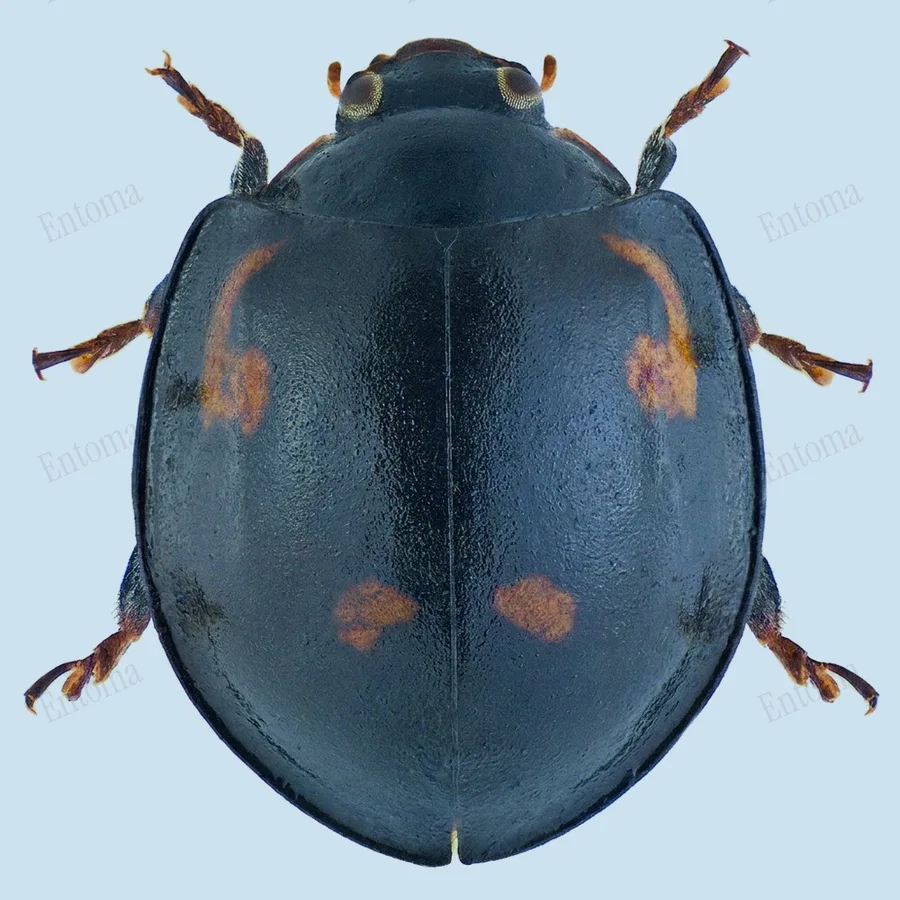
Pine ladybird
It hunts scale insects and woolly aphids sheltering deep in bark crevices, prey too well protected for most other ladybirds to reach.
| Where | Woodland, hedgerows, and gardens |
|---|---|
| Size | 3 to 4.5 mm long |
| When | February to October |
This small ladybird has black wing cases marked with two comma shaped and two round red spots, edged by a narrow raised rim. It measures only 3 to 4.5 mm long, among the smallest ladybirds found in woodland and gardens.
It hunts scale insects, adelgids, and woolly aphids sheltering in bark crevices, and overwinters in leaf litter or among the foliage of evergreen trees and shrubs before becoming active again in late winter.
Traits
Habitat
Woodland
Colour
Black, Red
Active
Day
To people
Harmless to people.
Activity through the year
Often confused with
The kidney-spot ladybird is slightly larger at 4 to 5 mm and carries only two round red spots, compared with the pine ladybird's four spots, two of them comma shaped.
Questions
Is the Pine ladybird dangerous to people?
Harmless to people.
When can you see the Pine ladybird?
The Pine ladybird can be seen from February to October, by day.
Plate retouched from a photo by Udo Schmidt from Deutschland, CC BY‑SA 2.0, Wikimedia Commons Licence
The plate on this page is shared under the same licence as its source, CC BY-SA.
Report a mistake in this entry
Last updated 2026-09-26. Every entry is checked against published sources.