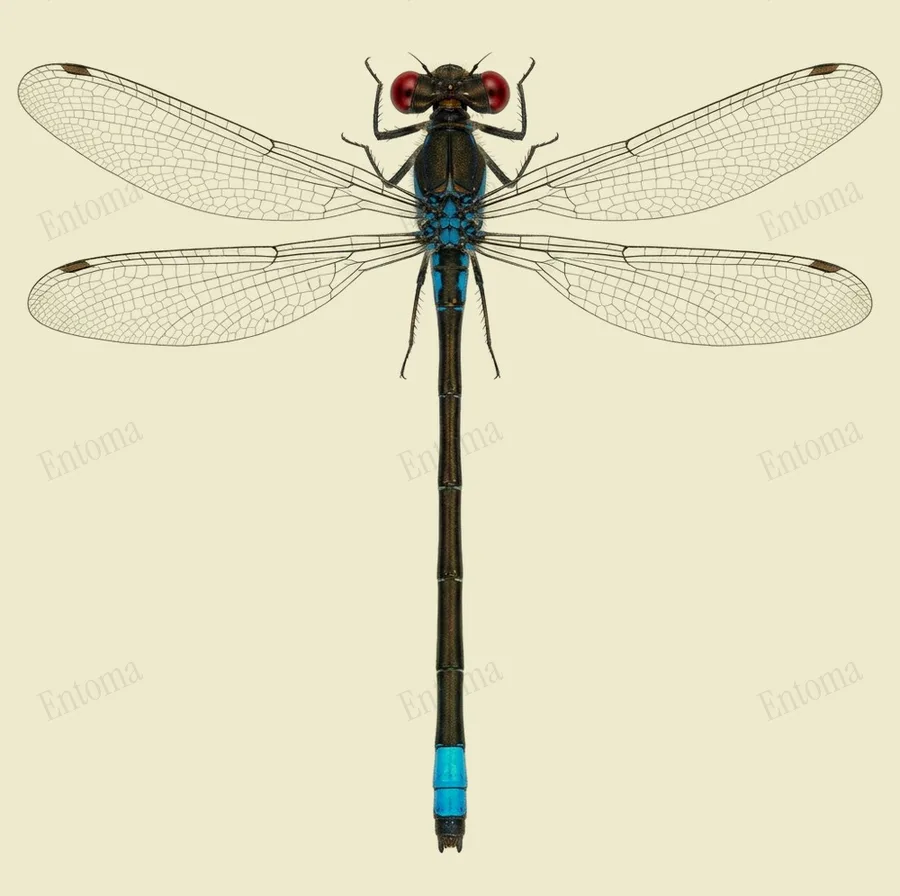
Red-eyed damselfly
Territorial males perch for hours on lily pads far from shore, and mating pairs can stay submerged for up to thirty minutes while laying eggs into floating leaves.
| Where | Lakes and ponds with lilies |
|---|---|
| Size | 33 to 36 mm body length |
| When | May to August |
The Red-eyed damselfly is a robust damselfly about 33 to 36 mm long, mostly black with iridescent blue markings on the thorax and the tip of the abdomen. Mature males have deep red eyes, while females and young males are yellow and black.
Males spend much of their time perched on floating leaves such as water lilies, guarding territory well out from the bank. Mating pairs stay joined while laying eggs into floating or emergent leaves, sometimes submerging together for up to thirty minutes, from May to August.
Traits
Habitat
Wetland
Colour
Black, Blue
Active
Day
To people
Harmless to people; does not sting or bite.
Activity through the year
Often confused with
Smaller at about 29 mm, with more extensive blue on the sides of the second and last abdominal segments and orangish rather than deep red eyes.
Questions
Is the Red-eyed damselfly dangerous to people?
Harmless to people; does not sting or bite.
When can you see the Red-eyed damselfly?
The Red-eyed damselfly can be seen from May to August, by day.
Plate retouched from a museum specimen photo by Estonian Museum of Natural History, CC BY 4.0, GBIF Licence
Report a mistake in this entry
Dragonflies and damselflies›Narrow-winged damselflies›Erythromma
Last updated 2026-09-26. Every entry is checked against published sources.