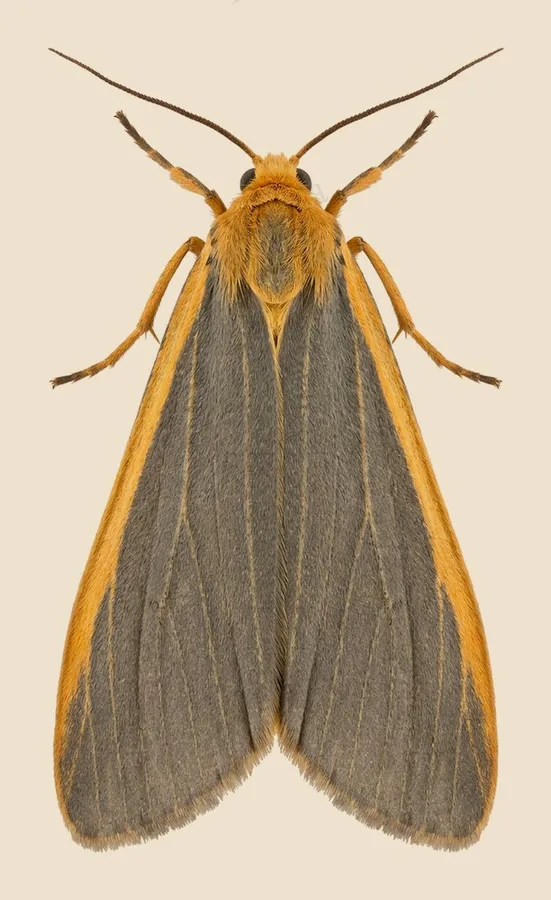
Common footman
The Common footman rests with its narrow forewings folded flat and rolled around its body like a rolled-up scroll, rather than tented as most moths do.
| Where | Gardens, farmland and woodland with lichen |
|---|---|
| Size | 28 to 38 mm wingspan |
| When | June to August |
The Common footman has greenish-grey forewings with a leading yellow stripe that tapers to a point, and pale yellow hindwings that show briefly in flight. Its narrow, tightly folded resting posture separates it from several similar footman species.
Adults fly mainly in July and August and are frequent visitors to light. Caterpillars feed on lichens growing on bark, walls and fences, occasionally also nibbling the foliage of shrubs such as hawthorn.
Traits
Habitat
Garden
Colour
Green, Grey, Yellow
Active
Night
To people
Comes to light at night; poses no known risk to people.
Activity through the year
Often confused with
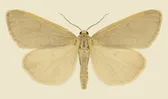
A similar 32 to 40 mm wingspan, but with broader, more rounded, melon-seed shaped forewings and a curved leading edge that the narrower Common footman lacks.
Questions
Is the Common footman dangerous to people?
Comes to light at night; poses no known risk to people.
When can you see the Common footman?
The Common footman can be seen from June to August, at night.
Plate retouched from a photo by janet graham, CC BY 2.0, Wikimedia Commons Licence
Report a mistake in this entry
Butterflies and moths›Erebid moths›Eilema
Last updated 2026-09-26. Every entry is checked against published sources.