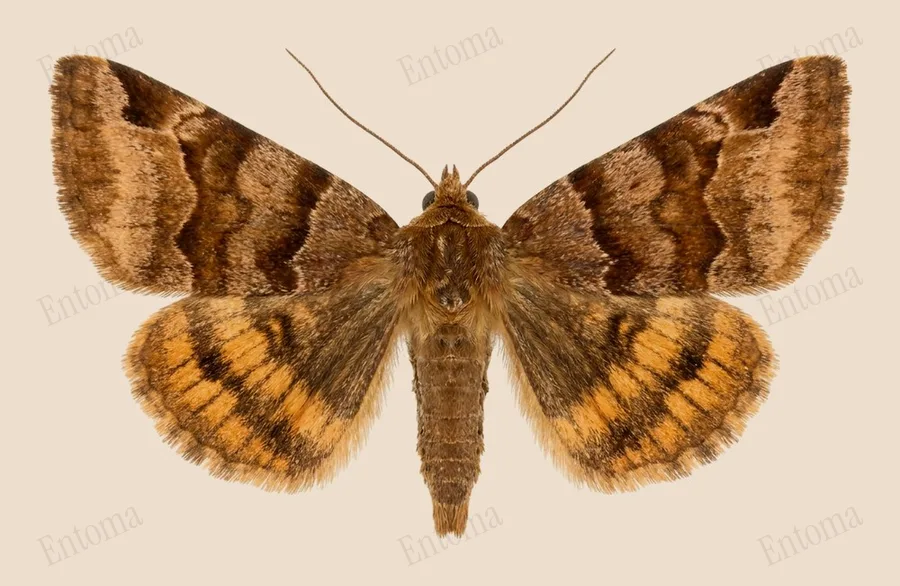
Burnet companion
It often flies by day alongside burnet moths, the mistaken-identity company that gives it its common name, even though the two are not closely related.
| Where | Grassland and flower-rich meadows |
|---|---|
| Size | 26 to 30 mm wingspan |
| When | April to August |
The burnet companion has warm brown forewings crossed by two darker bands and a dark blotch near each tip, contrasting with bright orange yellow hindwings marked with dark wavy lines.
Caterpillars feed on clover and trefoil, and the single generation of adults flies by day in sunshine across grassy habitats, often alongside burnet moths and other day-flying species.
Traits
Habitat
Grassland
Colour
Orange, Brown
Active
Day
To people
Harmless to people.
Activity through the year
Often confused with
The mother shipton is a similar size at 25 to 30 mm but has mottled greyish brown forewings marked with a pattern resembling a face, lacking the burnet companion's orange hindwings.
Questions
Is the Burnet companion dangerous to people?
Harmless to people.
When can you see the Burnet companion?
The Burnet companion can be seen from April to August, by day.
Plate retouched from a photo by NobbiP, CC BY‑SA 3.0, Wikimedia Commons Licence
The plate on this page is shared under the same licence as its source, CC BY-SA.
Report a mistake in this entry
Butterflies and moths›Erebid moths›Euclidia
Last updated 2026-09-26. Every entry is checked against published sources.