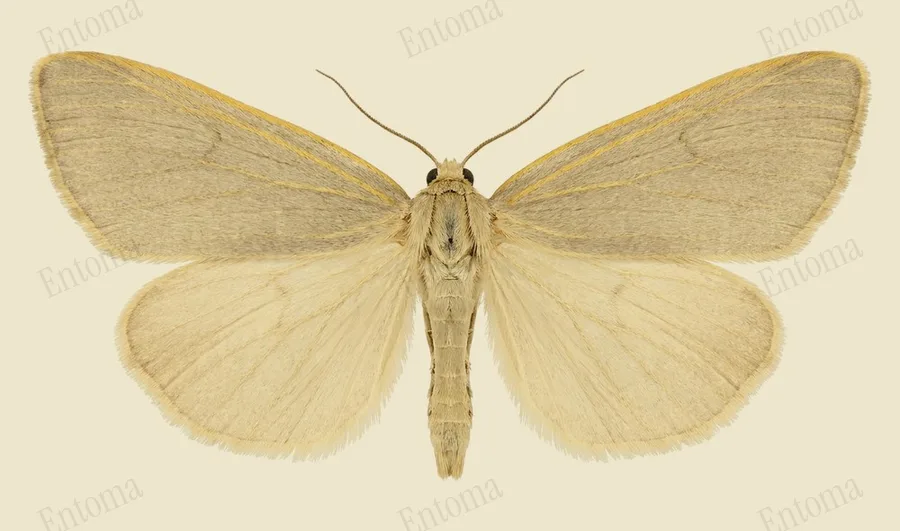
Dingy footman
This footman moth holds its forewings in a broad, rounded shape at rest, unlike the narrower, tightly wrapped wings of most other footman moths sharing its habitat.
| Where | Damp woodland, fens and water meadows |
|---|---|
| Size | 32 to 40 mm wingspan |
| When | July to August |
The Dingy Footman is a grey moth, sometimes with a yellowish form, that holds its broader, more rounded forewings in an oval shape at rest, unlike the narrower wings of related footman species. A pale stripe runs along the leading edge of the forewing.
Caterpillars feed on lichens growing on the bark of deciduous trees and bushes in damp places. Adults fly from June to September and are found in fens, damp woodland and water meadows across much of Europe.
Traits
Habitat
Wetland
Colour
Grey, Yellow
Active
Night
To people
Comes to light after dark; harmless to people.
Activity through the year
Often confused with
Similar size at about 28 to 35 mm wingspan, but with narrower wings held tightly furled around the body and yellow legs, rather than the broad oval wings of the Dingy Footman.
Questions
Is the Dingy footman dangerous to people?
Comes to light after dark; harmless to people.
When can you see the Dingy footman?
The Dingy footman can be seen from July to August, at night.
Plate retouched from a museum specimen photo by Aronen, M., Finnish Museum of Natural History - Zoology Unit, CC BY 4.0, GBIF Licence
Report a mistake in this entry
Butterflies and moths›Erebid moths›Eilema
Last updated 2026-09-26. Every entry is checked against published sources.