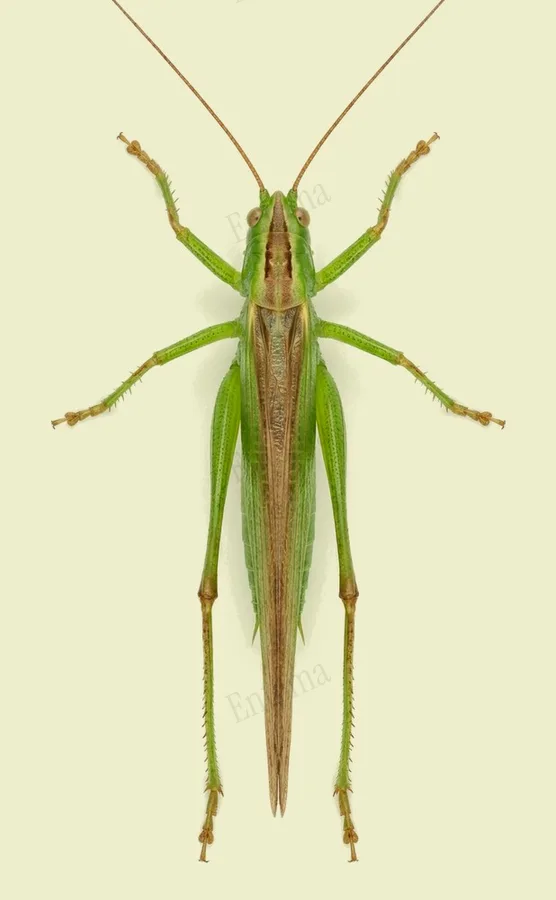
Long-winged conehead
Unlike its short-winged relative, this bush-cricket can fly on its full-length wings, helping it spread rapidly across new ground over recent decades.
| Where | Rough grassland, heathland and reedbeds |
|---|---|
| Size | 14 to 22 mm body length |
| When | June to October |
The long-winged conehead is a slender green bush-cricket with brown wings that extend past the tip of the abdomen and a brown stripe running down the head and pronotum. Females carry a long, straight ovipositor.
It lives in rough grassland, reedbeds, heathland and coastal marshes, feeding on grasses and small insects, and is active by day, often calling from low in dense vegetation.
Traits
Habitat
Grassland
Colour
Green, Brown
Active
Day
To people
Feeds on plants and small insects and poses no risk to people.
Activity through the year
Often confused with
Very similar, but its wings cover only about half the abdomen and it cannot fly, unlike the fully winged long-winged conehead.
Questions
Is the Long-winged conehead dangerous to people?
Feeds on plants and small insects and poses no risk to people.
When can you see the Long-winged conehead?
The Long-winged conehead can be seen from June to October, by day.
Plate retouched from a photo by Mikko Heikkinen, CC BY 4.0, iNaturalist Licence
Report a mistake in this entry
Crickets and grasshoppers›Bush crickets›Conocephalus
Last updated 2026-09-26. Every entry is checked against published sources.