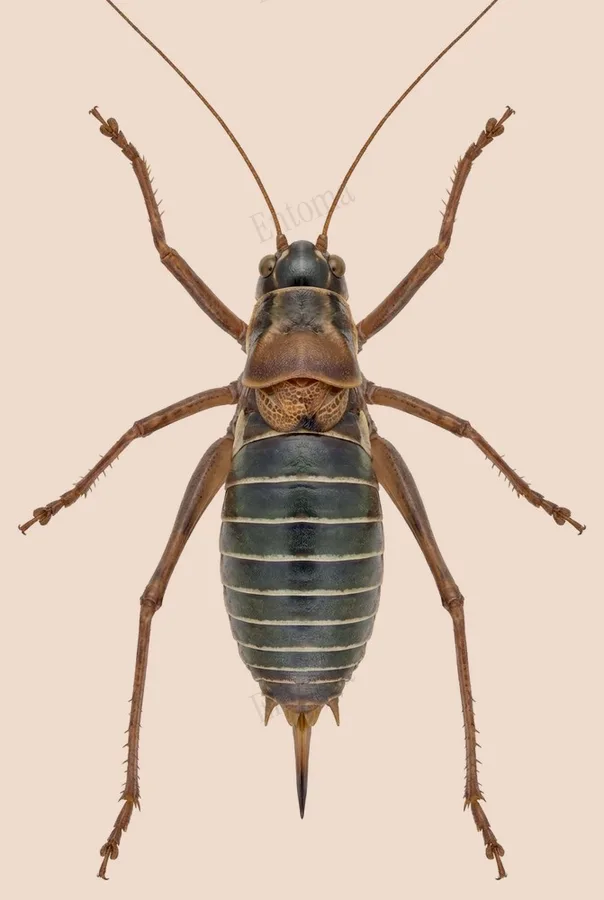
Western saddle bush-cricket
This bush-cricket's wings are reduced to small stubs on its back, so despite its bulky body it can never fly away from danger.
| Where | Dry grasslands, scrub and vineyards |
|---|---|
| Size | 22 to 30 mm body length |
| When | June to October |
The Western Saddle Bush-cricket is a bulky, variably green to brown bush-cricket with wing stubs too small for flight, a saddle-shaped pronotum and a black-marked nape. Females carry a long, gently curved ovipositor nearly as long as the body.
It lives in dry grassland, scrub, vineyard margins and open woodland edges, often on sunny slopes, where it feeds on low plants and other insects. Males call with a short, sharp song produced by rubbing the bases of their stub wings together.
Traits
Habitat
Grassland
Colour
Green, Brown
Active
Day
To people
Harmless to people; flightless and slow-moving, it relies on camouflage rather than defense.
Activity through the year
Often confused with
It lacks the black marking on the nape and is found further east in central Europe, while the Western Saddle Bush-cricket shows that black mark and occurs further west.
Questions
Is the Western saddle bush-cricket dangerous to people?
Harmless to people; flightless and slow-moving, it relies on camouflage rather than defense.
When can you see the Western saddle bush-cricket?
The Western saddle bush-cricket can be seen from June to October, by day.
Plate retouched from a photo by Fabien Anthelme, CC BY‑SA 4.0, iNaturalist Licence
The plate on this page is shared under the same licence as its source, CC BY-SA.
Report a mistake in this entry
Crickets and grasshoppers›Bush crickets›Ephippiger
Last updated 2026-09-26. Every entry is checked against published sources.