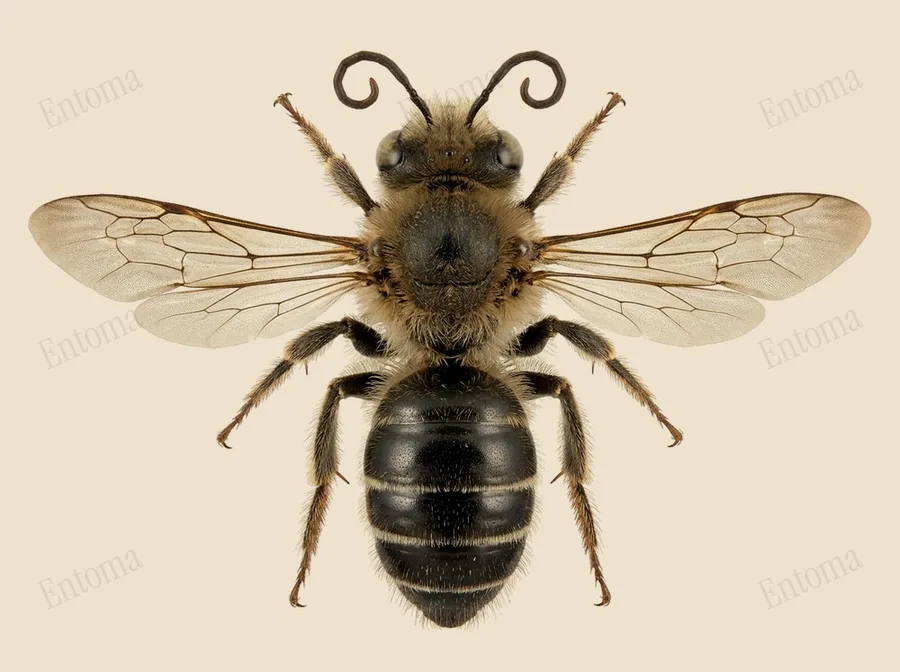
Early cellophane bee
Females paint the inside of each brood cell with a clear, waterproof secretion that dries into a cellophane like lining.
| Where | Coastal dunes and sandy heaths |
|---|---|
| Size | 9 to 11 mm body length |
| When | March to May |
This is the largest cellophane bee in Europe, with females around 10 to 11 mm long and males a little smaller and slimmer. The thorax carries dense brownish hair, while the abdomen is black and largely without the pale hair bands seen in many other Colletes species.
Females dig nest tunnels 45 to 55 cm deep into loose sand, often on dunes or sandy heathland, and line each brood cell with a transparent, waterproof secretion from the Dufour's gland; males emerge in mass swarms ahead of the females each spring and cluster around nest entrances waiting for them to appear.
Traits
Habitat
Coast
Colour
Black, Brown
Active
Day
To people
Like other solitary bees, females rarely sting unless handled roughly, and the mass spring emergence of males over dunes poses no danger to people nearby.
Activity through the year
Often confused with
The grey-backed mining bee is larger at 13 to 15 mm long against 9 to 11 mm in the early cellophane bee, and its thorax is covered in solid grey hair rather than the early cellophane bee's brown hair and bare black abdomen.
Questions
Is the Early cellophane bee dangerous to people?
Like other solitary bees, females rarely sting unless handled roughly, and the mass spring emergence of males over dunes poses no danger to people nearby.
When can you see the Early cellophane bee?
The Early cellophane bee can be seen from March to May, by day.
Plate retouched from a photo by Janet Graham, CC BY 2.0, Wikimedia Commons Licence
Report a mistake in this entry
Bees, wasps and ants›Plasterer bees›Colletes
Last updated 2026-09-26. Every entry is checked against published sources.