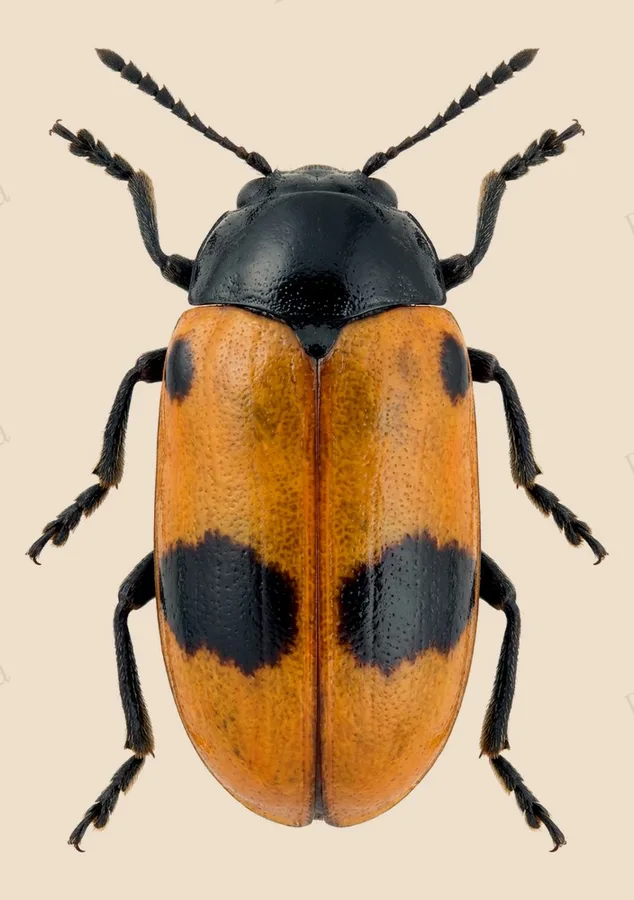
Willow clytra
Females coat each egg in a pellet of their own droppings and drop it near an ant nest, where ants unwittingly carry the beetle egg inside.
| Where | Deciduous woodland edges and hedgerows |
|---|---|
| Size | 8 to 12 mm body length |
| When | May to July |
The Willow clytra is a shiny leaf beetle 8 to 12 mm long, with red-orange elytra marked by four black spots, two larger ones near the centre and two smaller ones on the shoulders. The head, legs and shiny prothorax are black.
Larvae develop for about two years inside the nests of ants such as Formica and Lasius, building a portable case from waste material that shields them while they feed on nest debris. Adults feed on the leaves and pollen of oak, willow and birch from May to July.
Traits
Habitat
Woodland
Colour
Red, Orange, Black
Active
Day
To people
Harmless to people; the larvae live unseen inside ant nests.
Activity through the year
Often confused with
Similar size at about 8 to 10 mm, but with smaller, more rounded shoulder spots and a duller, finely pitted pronotum instead of the smooth, shiny one of the Willow clytra.
Questions
Is the Willow clytra dangerous to people?
Harmless to people; the larvae live unseen inside ant nests.
When can you see the Willow clytra?
The Willow clytra can be seen from May to July, by day.
Plate retouched from a museum specimen photo by National Museum of Natural History, Luxembourg, CC0, GBIF Licence
Report a mistake in this entry
Last updated 2026-09-26. Every entry is checked against published sources.