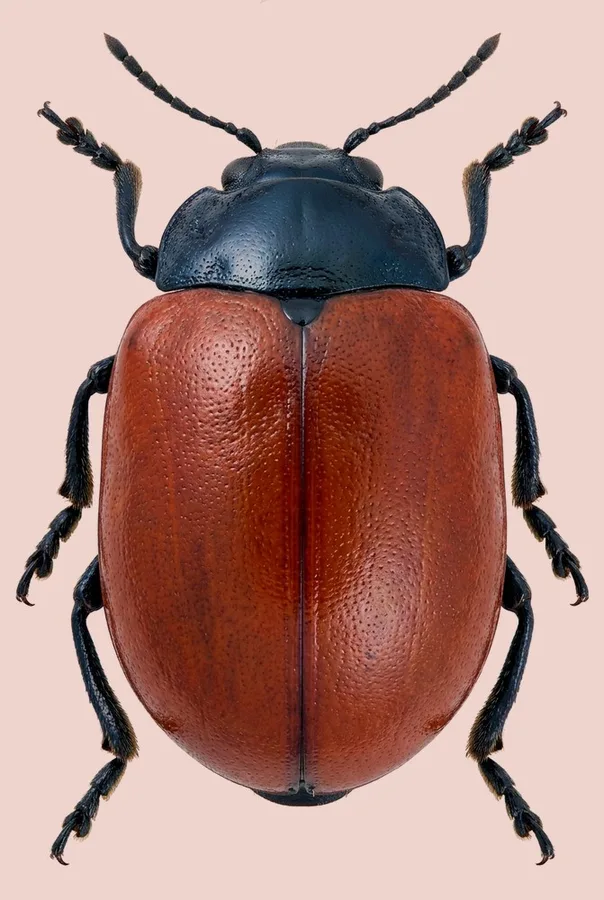
Poplar leaf beetle
When threatened, this beetle's larvae ooze a bright red fluid made from tree chemicals, a defence effective enough that predators often reject and drop them.
| Where | Poplar and willow woodland |
|---|---|
| Size | 9 to 13 mm body length |
| When | April to September |
Adults have glossy red wing cases with a small black spot near the tip, set against a black head and thorax, while the pale grey larvae carry rows of black spots along the body.
Both larvae and adults feed on poplar and willow leaves, and glands convert plant chemicals into a strong smelling red secretion that is released onto attacking ants and birds.
Traits
Habitat
Woodland
Colour
Red, Black
Active
Day
To people
Does not bite or sting; its defensive fluid targets predators such as ants and birds, not people.
Activity through the year
Often confused with
A similar bright red and black beetle up to about 10 mm, smaller than the Poplar leaf beetle and lacking the small black spot at the tip of the elytra.
Questions
Is the Poplar leaf beetle dangerous to people?
Does not bite or sting; its defensive fluid targets predators such as ants and birds, not people.
When can you see the Poplar leaf beetle?
The Poplar leaf beetle can be seen from April to September, by day.
Plate retouched from a museum specimen photo by Gunnar Engan, Norwegian Biodiversity Information Centre, CC BY 4.0, GBIF Licence
Report a mistake in this entry
Beetles›Leaf beetles›Chrysomela
Last updated 2026-09-26. Every entry is checked against published sources.