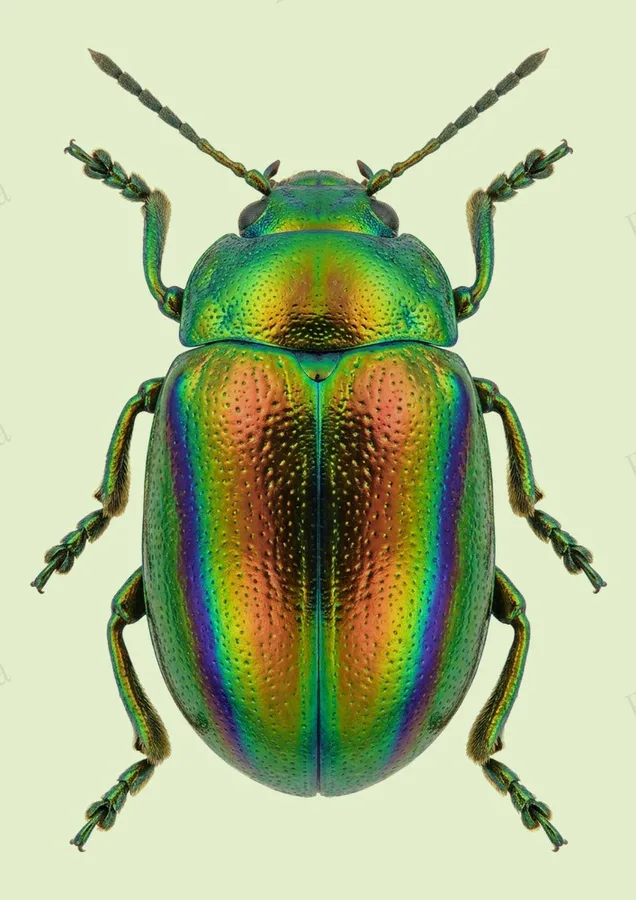
Dead-nettle leaf beetle
This leaf beetle was moved into its own genus in 2023, and its elytra shift from gold to green or violet blue along the shoulder and central seam.
| Where | Meadows, woodland edges and gardens |
|---|---|
| Size | 5 to 7 mm body length |
| When | March to October |
The Dead-nettle leaf beetle has a golden sheen that shifts to green or violet blue along the shoulders and central seam of the elytra, and some individuals appear wholly green or black.
Adults and larvae feed on dead-nettles and related plants in open, flowery habitats, and the species is sometimes confused with the larger Tansy beetle where their ranges overlap.
Traits
Habitat
Grassland
Colour
Metallic, Green
Active
Day
To people
Does not bite or sting; found openly on dead-nettle and related plants.
Activity through the year
Often confused with
Noticeably larger at 7.7 to 10.5 mm with a more uniform bright green sheen, compared with the smaller 5 to 7 mm Dead-nettle leaf beetle and its shifting gold and violet tones.
Questions
Is the Dead-nettle leaf beetle dangerous to people?
Does not bite or sting; found openly on dead-nettle and related plants.
When can you see the Dead-nettle leaf beetle?
The Dead-nettle leaf beetle can be seen from March to October, by day.
Plate retouched from a photo by Michael Knapp, CC BY 4.0, iNaturalist Licence
Report a mistake in this entry
Last updated 2026-09-26. Every entry is checked against published sources.