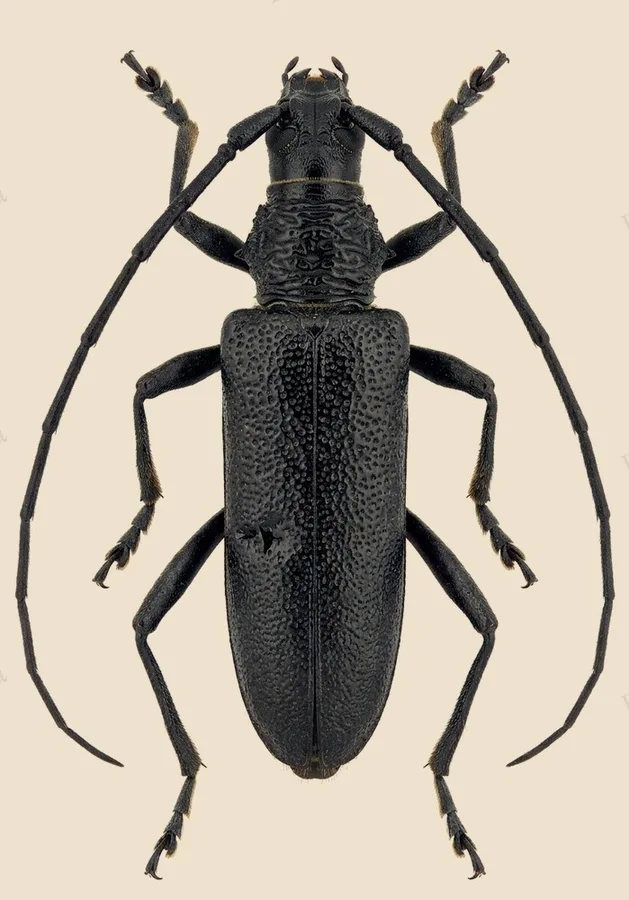
Lesser capricorn beetle
Its wood boring larvae can take more than a year to develop inside oak or chestnut trunks, and dense infestations occasionally weaken or kill a tree.
| Where | Woodland, hedgerows and log piles |
|---|---|
| Size | 17 to 28 mm body length |
| When | April to July |
The Lesser capricorn beetle is entirely shiny black, with a noticeably wrinkled pronotum and long, tapering elytra covered in fine wrinkles.
Larvae bore into the wood of oak, willow and chestnut, and adults often bask openly on cut logs and woodpiles through spring and early summer.
Traits
Habitat
Woodland
Colour
Black
Active
Day
To people
Does not bite or sting people, though dense larvae can weaken infested trees.
Activity through the year
Often confused with
Much larger at 41 to 55 mm, making it one of the biggest beetles in Europe, compared with the modest 17 to 28 mm of the Lesser capricorn beetle.
Questions
Is the Lesser capricorn beetle dangerous to people?
Does not bite or sting people, though dense larvae can weaken infested trees.
When can you see the Lesser capricorn beetle?
The Lesser capricorn beetle can be seen from April to July, by day.
Plate retouched from a photo by Слободан Стевчић, CC BY‑SA 4.0, Wikimedia Commons Licence
The plate on this page is shared under the same licence as its source, CC BY-SA.
Report a mistake in this entry
Beetles›Longhorn beetles›Cerambyx
Last updated 2026-09-26. Every entry is checked against published sources.