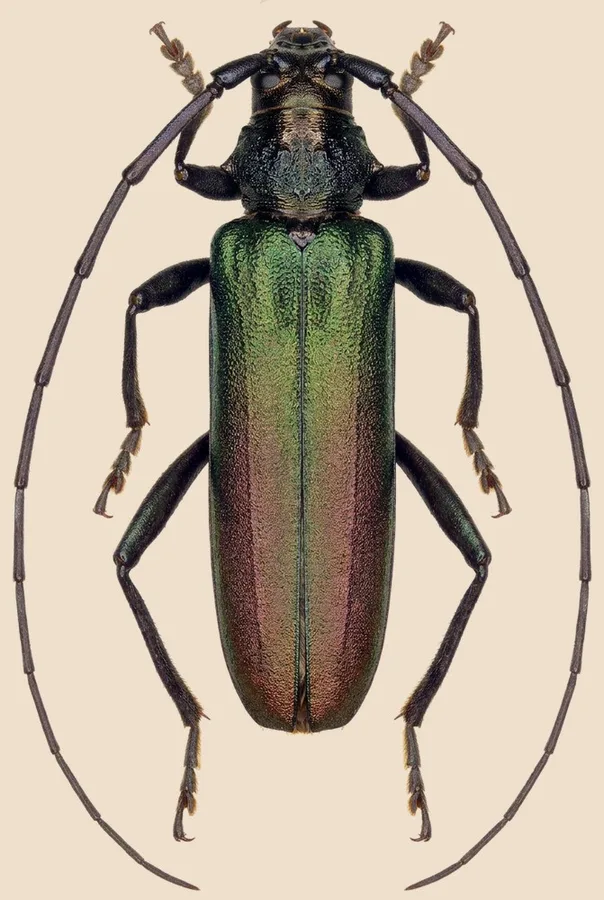
Musk beetle
When threatened, this beetle releases a musky secretion containing rose oxide, a compound also prized as one of perfumery's most valued fragrances.
| Where | Willows and other waterside trees |
|---|---|
| Size | 20 to 40 mm body length |
| When | June to August |
The musk beetle is a large, elongated longhorn with a metallic green to bluish-black body and a coppery sheen, and antennae that often exceed its own body length.
Adults are active in summer, often found on willow and other waterside trees, and release a musky-smelling defensive secretion from glands near the hind legs when handled.
Traits
Habitat
Wetland
Colour
Green, Metallic
Active
Day
To people
Harmless to handle; releases a strong musky smell rather than biting when disturbed.
Activity through the year
Often confused with
Smaller at 25 to 35 mm, with shiny black elytra and a reddish pronotum, though some musk beetle forms also show a red pronotum, so overall size and leg length help confirm identity.
Questions
Is the Musk beetle dangerous to people?
Harmless to handle; releases a strong musky smell rather than biting when disturbed.
When can you see the Musk beetle?
The Musk beetle can be seen from June to August, by day.
Plate retouched from a photo by Gubin Olexander, CC BY‑SA 4.0, Wikimedia Commons Licence
The plate on this page is shared under the same licence as its source, CC BY-SA.
Report a mistake in this entry
Beetles›Longhorn beetles›Aromia
Last updated 2026-09-26. Every entry is checked against published sources.