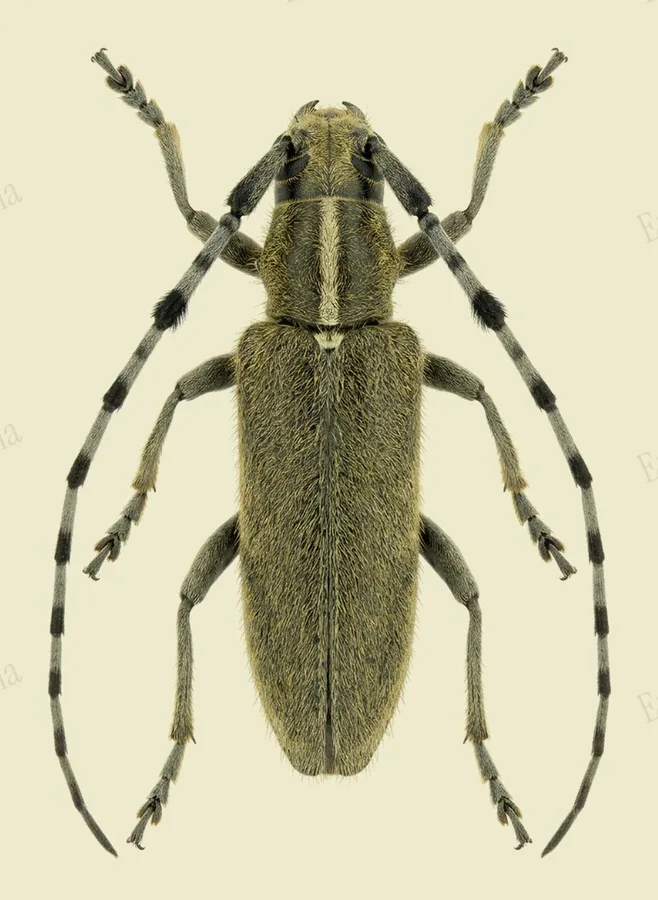
Golden-bloomed longhorn beetle
Females gnaw a small hole into a living plant stem to lay a single egg, and the larva then tunnels and feeds inside the stem for months.
| Where | Wet grasslands, verges and woodland edges |
|---|---|
| Size | 10 to 22 mm body length |
| When | May to July |
The Golden-bloomed longhorn beetle is a slender, cylindrical beetle 10 to 22 mm long, covered in fine golden-yellow down over a black body that gives it a golden sheen. Its antennae are longer than the body and clearly two-toned, pale on the inner edge of each segment and dark on the outer.
Females gnaw into the stem of a host plant such as thistle, hogweed or nettle and lay a single egg inside, and the larva develops within the living stem. Adults are seen by day on umbellifer flowers such as cow parsley and hogweed from late spring into summer.
Traits
Habitat
Grassland
Colour
Black, Yellow
Active
Day
To people
Does not sting or bite; harmless to handle if found resting on flowers.
Activity through the year
Often confused with
Similar dark, yellow-haired look at 9 to 15 mm, but stockier, with a pronotum only slightly narrower than the elytra rather than the strongly narrowed pronotum of the Golden-bloomed longhorn.
Questions
Is the Golden-bloomed longhorn beetle dangerous to people?
Does not sting or bite; harmless to handle if found resting on flowers.
When can you see the Golden-bloomed longhorn beetle?
The Golden-bloomed longhorn beetle can be seen from May to July, by day.
Plate retouched from a museum specimen photo by Uno Roosileht, Estonian Museum of Natural History, CC BY 4.0, GBIF Licence
Report a mistake in this entry
Beetles›Longhorn beetles›Agapanthia
Last updated 2026-09-26. Every entry is checked against published sources.