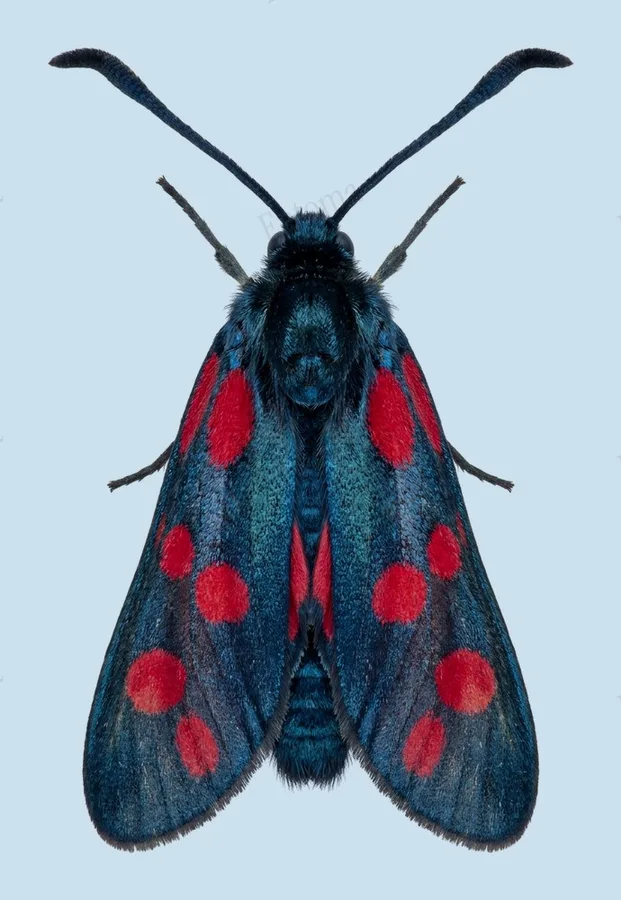
Six-spot burnet
It carries cyanide in its body at every life stage and will ooze a foul yellow fluid containing the poison if a bird tries to eat it.
| Where | Flowery meadows, cliffs, grassy clearings |
|---|---|
| Size | 30 to 40 mm wingspan |
| When | May to August |
This day-flying moth has dark, metallic green forewings marked with six bright red spots, and plain red hindwings edged in blackish fringe.
Caterpillars feed on bird's-foot trefoil and related clovers, then spend the winter as larvae before spinning a papery cocoon on a grass stem to pupate in early summer.
Traits
Habitat
Grassland
Colour
Green, Red, Black
Active
Day
To people
Mild
Harmless to touch; it contains cyanide compounds and is toxic if eaten.
Activity through the year
Often confused with
The five-spot burnet has only five red spots on each forewing rather than six, and the two species can be hard to separate where their ranges overlap.
Questions
Is the Six-spot burnet dangerous to people?
Mild. Harmless to touch; it contains cyanide compounds and is toxic if eaten.
When can you see the Six-spot burnet?
The Six-spot burnet can be seen from May to August, by day.
Plate retouched from a photo by Bjoertvedt, CC BY‑SA 3.0, Wikimedia Commons Licence
The plate on this page is shared under the same licence as its source, CC BY-SA.
Report a mistake in this entry
Butterflies and moths›Burnet moths›Zygaena
Last updated 2026-09-26. Every entry is checked against published sources.