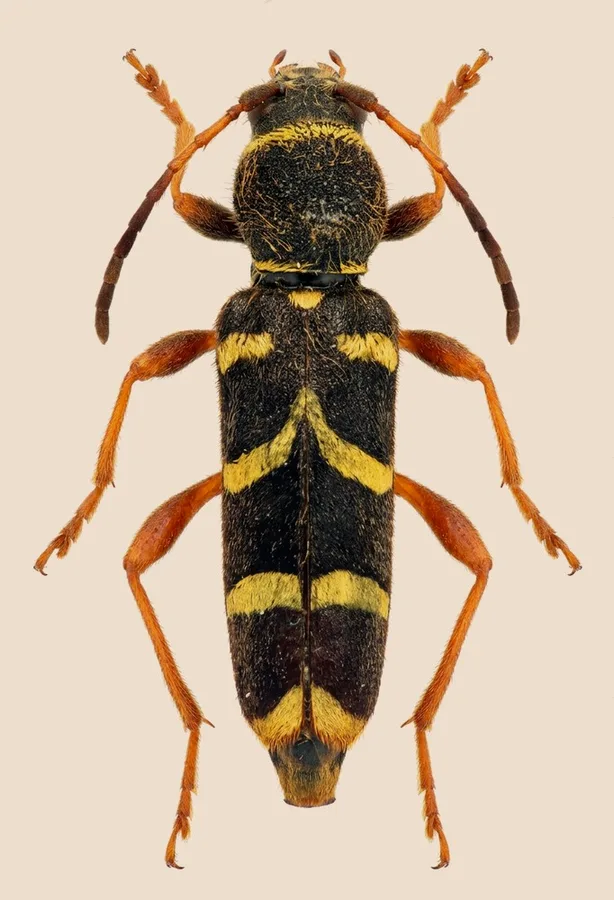
Wasp beetle
This harmless beetle plays the part of a wasp, jerking across flowers in short bursts and even buzzing like one when disturbed.
| Where | Woodland edges, fence posts, gardens |
|---|---|
| Size | 9 to 18 mm long |
| When | April to July |
The wasp beetle is black with narrow yellow bands across its body, and its short, two-toned antennae and compact shape mimic a wasp more closely than most other longhorn beetles.
Its larvae develop inside dry dead wood such as old fence posts and dead branches, favouring willow and birch, and adults emerge in sunny weather to visit flowers for pollen and nectar.
Traits
Habitat
Garden
Colour
Black, Yellow
Active
Day
To people
Harmless; mimics a wasp but cannot sting
Activity through the year
Often confused with
The four-banded longhorn beetle shows four separate yellow spots at the base of the wing cases and two continuous yellow bands, a different pattern from the wasp beetle's markings, and lacks its bicoloured antennae.
Questions
Is the Wasp beetle dangerous to people?
Harmless; mimics a wasp but cannot sting.
When can you see the Wasp beetle?
The Wasp beetle can be seen from April to July, by day.
Plate retouched from a photo by Алексей, CC0, Wikimedia Commons Licence
Report a mistake in this entry
Beetles›Longhorn beetles›Clytus
Last updated 2026-09-26. Every entry is checked against published sources.