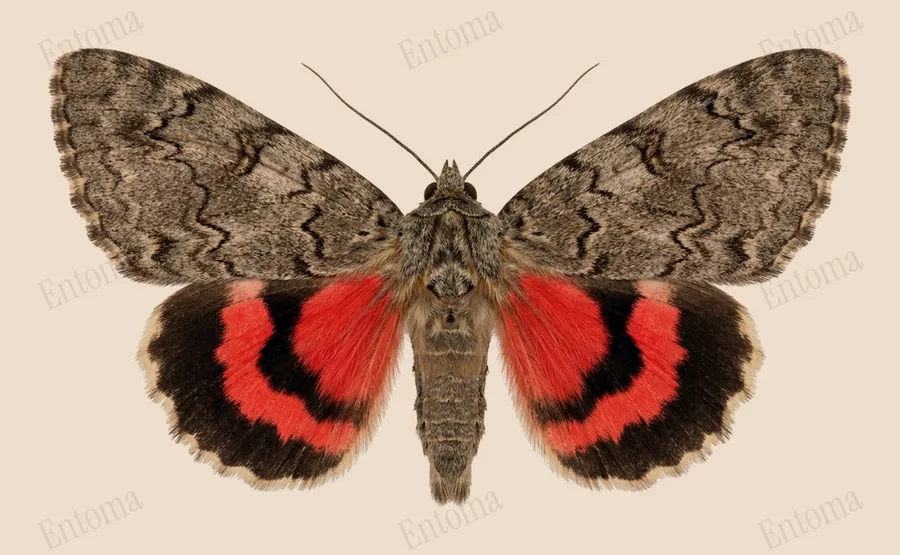
Red underwing
The Red underwing hides bright orange red hindwings banded in black beneath dull grey forewings, flashing them into view only when startled to surprise attacking birds.
| Where | Woodland, riverbanks and gardens |
|---|---|
| Size | 65 to 80 mm wingspan |
| When | July to October |
The Red underwing is a large moth with grey forewings crossed by jagged dark lines, camouflaged against bark. When disturbed it reveals hindwings colored deep orange red with a black band around the scalloped margin and a second black band across the centre, fringed with white.
Caterpillars feed on poplar and willow and rest flattened against the bark by day, and the species overwinters as an egg. Adults fly at night from July to October and readily come to light traps and sugar bait, though they are also often found resting openly on tree trunks, walls and fences.
Traits
Habitat
Woodland
Colour
Grey, Red
Active
Night
To people
Attracted to light and sugar bait at night; harmless to people.
Activity through the year
Often confused with
Smaller, about 60 to 66 mm wingspan, with a shallow W shaped black band crossing the hindwing rather than the broader, more continuous dark bands of the Red underwing, and largely restricted to warm oak woodland.
Questions
Is the Red underwing dangerous to people?
Attracted to light and sugar bait at night; harmless to people.
When can you see the Red underwing?
The Red underwing can be seen from July to October, at night.
Plate retouched from a photo by Dumi, CC BY‑SA 3.0, Wikimedia Commons Licence
The plate on this page is shared under the same licence as its source, CC BY-SA.
Report a mistake in this entry
Butterflies and moths›Erebid moths›Catocala
Last updated 2026-09-26. Every entry is checked against published sources.