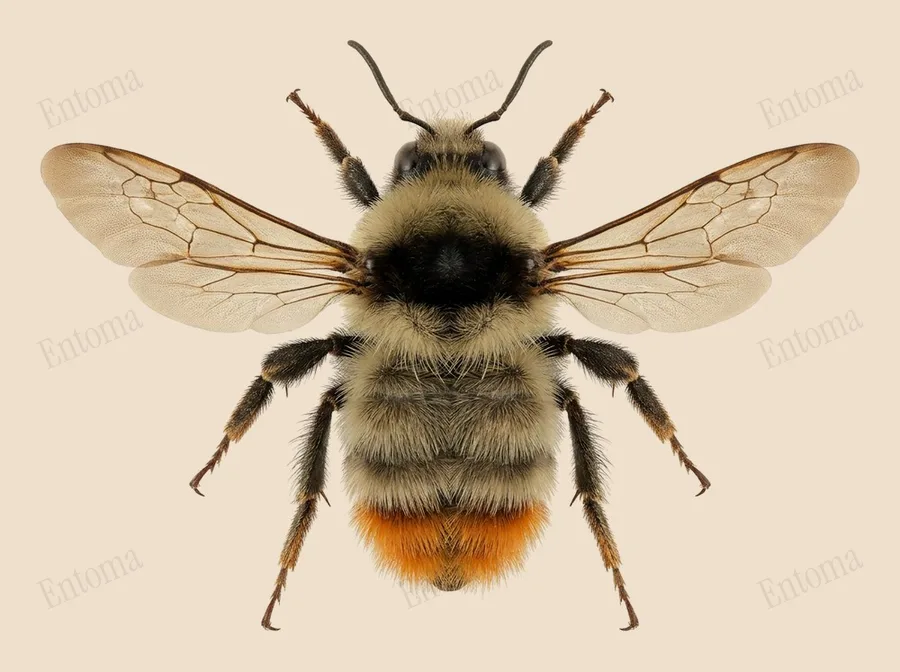
Shrill carder bumble bee
Its buzz is pitched noticeably higher than other bumblebees, and it has disappeared from most of its former range as grassland habitat declined.
| Where | Unimproved grassland and coastal sites |
|---|---|
| Size | 10 to 18 mm long |
| When | April to September |
This pale greyish yellow bee has a black band across the thorax, two dark bands on the abdomen, and a pale orange tip to the tail; queens measure 16 to 18 mm long and workers 10 to 15 mm.
It nests on or just below ground in dense grass, with workers appearing about six weeks after a nest is founded, and now survives mainly in a handful of wildflower-rich grassland and coastal sites.
Traits
Habitat
Grassland
Colour
Grey, Orange, Black
Active
Day
To people
Mild
Females can sting, as with other bumblebees, though this scarce species is rarely encountered.
Activity through the year
Often confused with
The brown-banded carder bee is a similar size at 10 to 18 mm long, but has bright ginger hair across its thorax and lacks the black thoracic band of the shrill carder bumble bee.
Questions
Is the Shrill carder bumble bee dangerous to people?
Mild. Females can sting, as with other bumblebees, though this scarce species is rarely encountered.
When can you see the Shrill carder bumble bee?
The Shrill carder bumble bee can be seen from April to September, by day.
Plate retouched from a photo by Arnstein Staverløkk, Norsk institutt for naturforskning, CC BY 3.0, Wikimedia Commons Licence
Report a mistake in this entry
Bees, wasps and ants›Bees and bumblebees›Bombus
Last updated 2026-09-26. Every entry is checked against published sources.