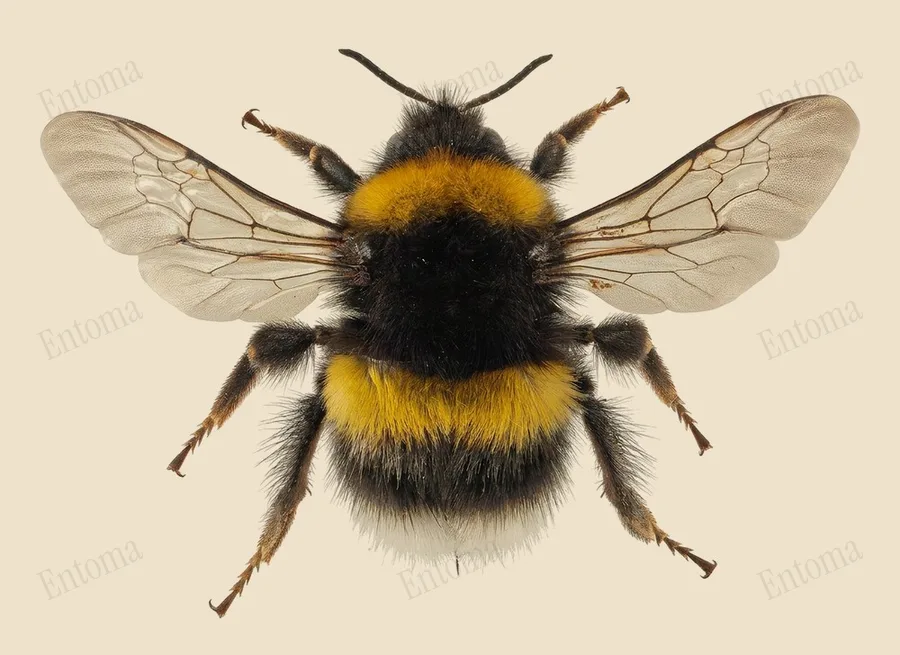
White-tailed bumblebee
Three near-identical bumblebee species, including this one, can only be told apart with certainty through DNA testing, not by appearance alone.
| Where | Gardens, hedgerows, and wildflower meadows |
|---|---|
| Size | 12 to 22 mm long |
| When | March to September |
This bee is black with a pale lemon-yellow collar, a yellow band on the second abdominal segment, and a clean white tail; queens measure 18 to 22 mm, workers 12 to 18 mm, and males 16 to 18 mm.
Queens emerge from hibernation as early as February to found nests in old rodent burrows underground, and workers and new queens continue foraging on garden and wildflower blooms into autumn.
Traits
Habitat
Garden
Colour
Black, Yellow, White
Active
Day
To people
Mild
Females can sting, as with all bumblebees, but they are docile and rarely do.
Activity through the year
Often confused with
The buff-tailed bumblebee is a similar size at 11 to 22 mm long, but its queen has a buff or cream-tinged tail rather than the crisp white tail of the white-tailed bumblebee.
Questions
Is the White-tailed bumblebee dangerous to people?
Mild. Females can sting, as with all bumblebees, but they are docile and rarely do.
When can you see the White-tailed bumblebee?
The White-tailed bumblebee can be seen from March to September, by day.
Plate retouched from a photo by Arnstein Staverløkk, Norsk institutt for naturforskning, CC BY 3.0, Wikimedia Commons Licence
Report a mistake in this entry
Bees, wasps and ants›Bees and bumblebees›Bombus
Last updated 2026-09-26. Every entry is checked against published sources.