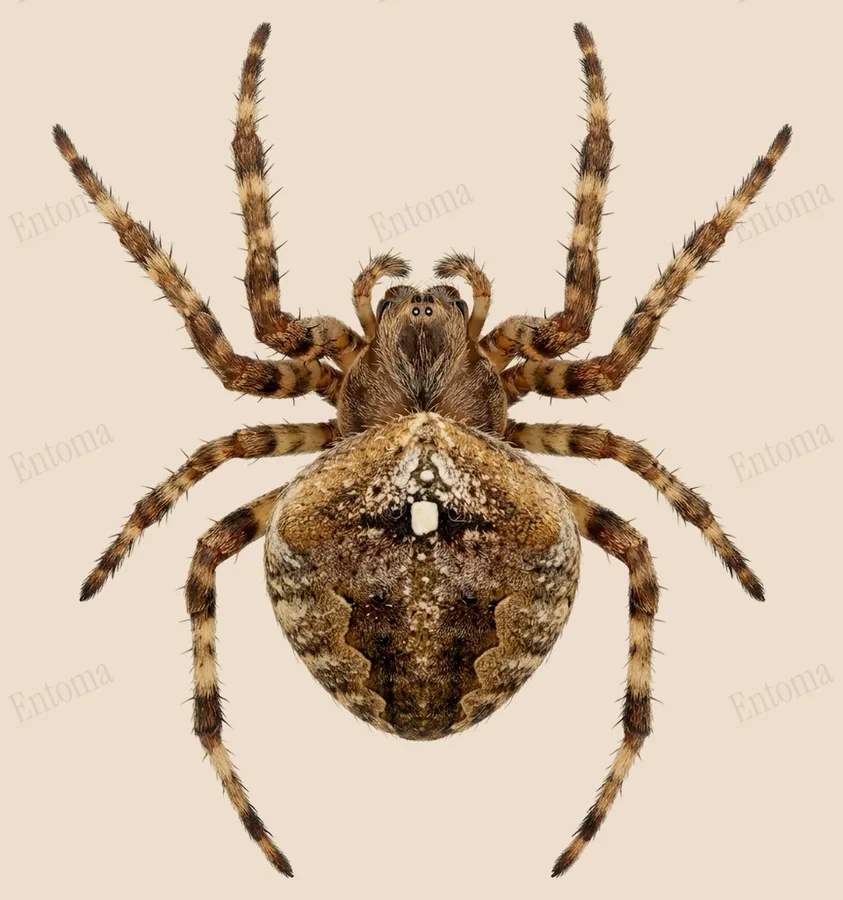
Angular orbweaver spider
Distinct angular humps on the front of the abdomen separate this orb weaver from the smoother bodied European garden spider it otherwise closely resembles.
| Where | Forest edges and tree trunks, Europe |
|---|---|
| Size | Female 12 to 20 mm, male 10 to 12 mm body length |
| When | April to October |
The Angular orbweaver spider closely resembles the common European garden spider but carries a pair of pointed tubercles, or humps, on the front of the abdomen, with a white cross shaped pattern between them on an otherwise dark brown body and light yellow, dark ringed legs.
It spins a large orb web among the branches of trees and bushes at forest edges, usually rebuilding the sticky spiral overnight and then sitting head down at the centre through the day to intercept flying insects.
Traits
Habitat
Woodland
Colour
Brown, Yellow, White
Active
Day and night
To people
A large but placid orb weaver with no documented bite to people; it stays centred in its web and shows little concern even when disturbed nearby.
Activity through the year
Often confused with
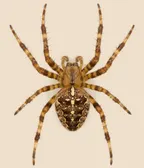
The European garden spider has a smoothly rounded abdomen marked with a pale cross, without the paired angular tubercles at the front of the abdomen that give Araneus angulatus its name.
Questions
Is the Angular orbweaver spider dangerous to people?
A large but placid orb weaver with no documented bite to people; it stays centred in its web and shows little concern even when disturbed nearby.
When can you see the Angular orbweaver spider?
The Angular orbweaver spider can be seen from April to October, by day and at night.
Plate retouched from a photo by Yurii Basov, CC BY 4.0, iNaturalist Licence
Report a mistake in this entry
Spiders›Orb-weaver spiders›Araneus
Last updated 2026-09-27. Every entry is checked against published sources.