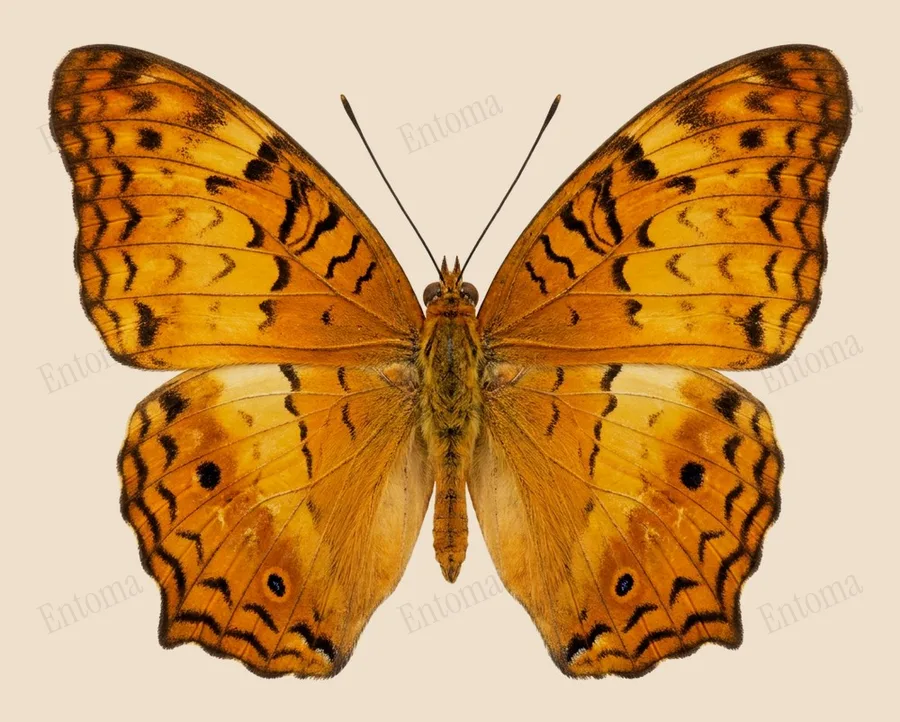
Malay cruiser
Females of this butterfly are pale greenish grey, so different from the rich orange brown males that early observers might easily mistake them for another species entirely.
| Where | Forest clearings and nature reserves |
|---|---|
| Size | 80 to 90 mm wingspan |
| When | January to December |
The male Malay cruiser is rich orange brown above with a paler band across both wings and dark submarginal lines, while the female is pale greenish grey with a white band and larger, more distinct eye markings on the hindwing. Both sexes have a short, pointed tail on the hindwing.
Caterpillars feed on Adenia vines, and adults are strong fliers that puddle on damp ground and visit flowering shrubs, staying mostly within forested nature reserves rather than open parks and gardens.
Traits
Habitat
Woodland
Colour
Orange, Brown, Grey
Active
Day
To people
Does not bite or sting; a strong flying butterfly that is harmless to people.
Activity through the year
Often confused with
The Malay lacewing has deeply scalloped wing margins with a black and white chequered border, unlike the smooth edged, unchequered wings of the Malay cruiser.
Questions
Is the Malay cruiser dangerous to people?
Does not bite or sting; a strong flying butterfly that is harmless to people.
When can you see the Malay cruiser?
The Malay cruiser can be seen from January to December, by day.
Plate retouched from a museum specimen photo by Swiss Natural History Collections - SwissNatColl, CC BY 4.0, GBIF Licence
Report a mistake in this entry
Butterflies and moths›Brush-footed butterflies›Vindula
Last updated 2026-09-27. Every entry is checked against published sources.