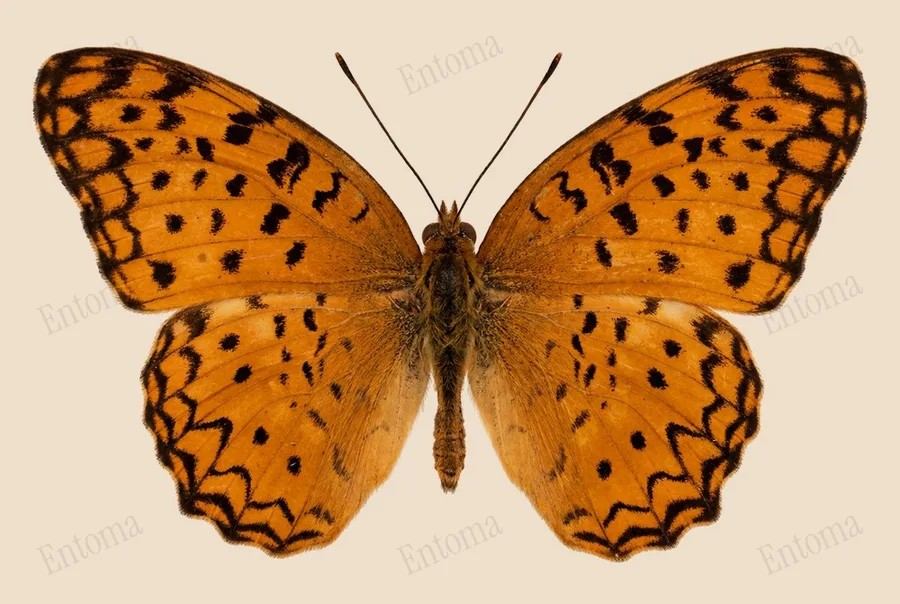
Common leopard
The common leopard prefers hot, dry, sunlit places and is rarely seen in shaded forest, ranging from lowland plains up to about 3000 metres in the Himalaya.
| Where | Open sunny plains, gardens and clearings |
|---|---|
| Size | 50 to 60 mm wingspan |
| When | January to December |
The common leopard is a medium sized, tawny orange butterfly marked above with rows of black spots and wavy black lines, the spots slightly larger in females; the underside is similarly patterned but more glossy, with a violet grey sheen that becomes more pronounced in the dry season form.
Caterpillars feed on plants such as governor's plum and various willow relatives, and adults favour hot, sunny, open places such as plains, gardens and forest clearings, becoming scarce in shaded forest interiors and ranging up into hills to around 3000 metres.
Traits
Habitat
Garden
Colour
Orange, Black, Brown
Active
Day
To people
Not known to bite or sting people.
Activity through the year
Often confused with
Underside pale yellow with a heavy row of black postdiscal spots, rather than the glossier, more uniformly tawny brown underside of the common leopard.
Questions
Is the Common leopard dangerous to people?
Not known to bite or sting people.
When can you see the Common leopard?
The Common leopard can be seen from January to December, by day.
Plate retouched from a museum specimen photo by Lee Kong Chian Natural History Museum, National University of Singapore, CC BY 4.0, GBIF Licence
Report a mistake in this entry
Butterflies and moths›Brush-footed butterflies›Phalanta
Last updated 2026-09-27. Every entry is checked against published sources.