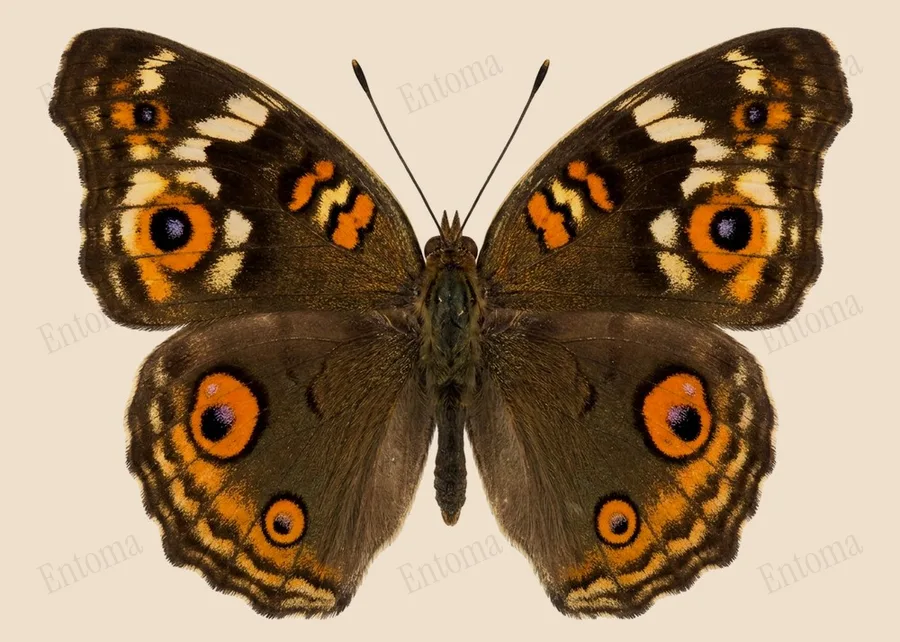
Lemon pansy
Lemon pansy caterpillars feed on plants including hemp, and the adult swaps its bold wet season eyespots for dull, leaf-like camouflage each dry season.
| Where | Gardens, fallow land and open woodland |
|---|---|
| Size | 45 to 60 mm wingspan |
| When | January to December |
The Lemon pansy is brown above with a scattering of black and lemon yellow eyespots and lines, each eyespot appearing singly rather than in a connected row. The wet season form has bold, rounded wings and vivid markings, while the dry season form is paler with jagged, angular wing edges that resemble a dead leaf at rest.
Caterpillars feed on low plants such as Barleria, Hygrophila and hemp, and adults bask often with wings spread flat, staying low to the ground in gardens and open wooded country across South and Southeast Asia.
Traits
Habitat
Garden
Colour
Brown, Yellow, Black
Active
Day
To people
Harmless to handle; adults bask openly and can be approached at close range.
Activity through the year
Often confused with
The Chocolate pansy shows its pale eyespots arranged in a connected series across each wing, while the Lemon pansy's black and lemon yellow eyespots sit apart from each other as separate marks.
Questions
Is the Lemon pansy dangerous to people?
Harmless to handle; adults bask openly and can be approached at close range.
When can you see the Lemon pansy?
The Lemon pansy can be seen from January to December, by day.
Plate retouched from a museum specimen photo by Swiss Natural History Collections - SwissNatColl, CC BY 4.0, GBIF Licence
Report a mistake in this entry
Butterflies and moths›Brush-footed butterflies›Junonia
Last updated 2026-09-27. Every entry is checked against published sources.