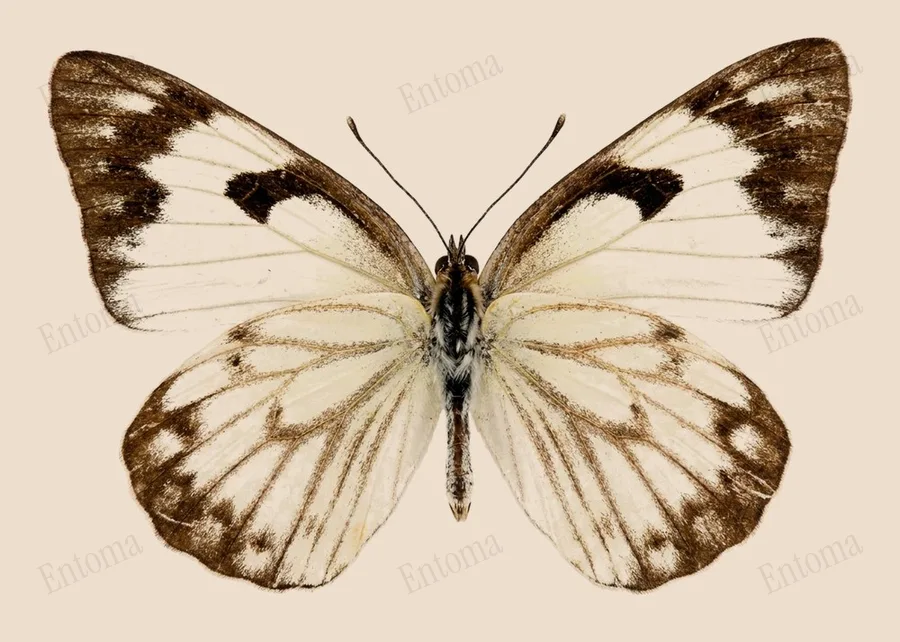
Pioneer white
Vast swarms of this white butterfly migrate across Africa and southern Asia in the same direction for days, crossing open country without stopping to feed.
| Where | Dry scrub, grassland and open gardens |
|---|---|
| Size | 39 to 50 mm wingspan |
| When | March to September |
The Pioneer white is a small to medium sized butterfly with white wings marked by black at the forewing tip and along the veins, the pattern heavier in the wet season form and lighter in the dry season form. Males and females look similar, with dark antennae flecked in white.
Caterpillars feed on shrubby capers of the genus Capparis and related plants, and adults gather at flowers and damp ground in large numbers before moving off together across open country in a fixed direction.
Traits
Habitat
Grassland
Colour
White, Black
Active
Day
To people
Visits flowers and damp patches in large gatherings; harmless to people.
Activity through the year
Often confused with
Larger, with a wingspan of about 60 to 74 mm against the Pioneer white's 39 to 50 mm, and shows only sparse black scaling at the forewing tip rather than a solid black patch.
Questions
Is the Pioneer white dangerous to people?
Visits flowers and damp patches in large gatherings; harmless to people.
When can you see the Pioneer white?
The Pioneer white can be seen from March to September, by day.
Plate retouched from a museum specimen photo by Swiss Natural History Collections - SwissNatColl, CC BY 4.0, GBIF Licence
Report a mistake in this entry
Butterflies and moths›Whites and yellows›Belenois
Last updated 2026-09-27. Every entry is checked against published sources.