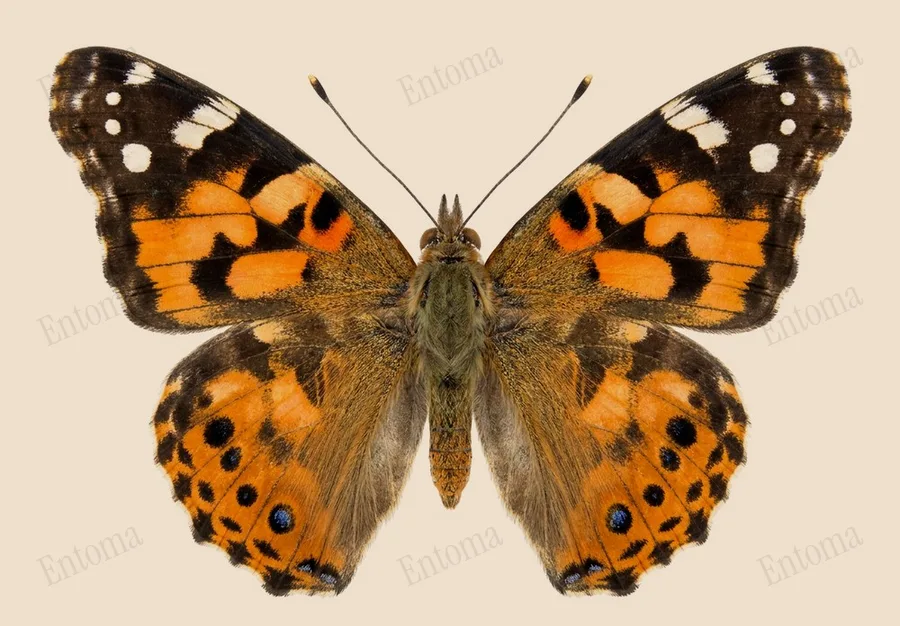
American lady
American lady caterpillars build a silk shelter among the leaves of everlasting plants, moving to a fresh leaf and spinning a new nest as they outgrow each one.
| Where | Gardens, meadows and old fields |
|---|---|
| Size | 37 to 66 mm wingspan |
| When | March to October |
The American lady has an uneven pattern of brown, orange and yellow above, with a black-tipped forewing showing a small white spot and a white bar near the leading edge. The underside of the hindwing carries two large blue-centered eyespots, the easiest way to tell it apart from the similar painted lady, which shows four small eyespots instead.
Caterpillars feed on everlasting, pussytoes and related plants in the daisy family across most of the United States and southern Canada, sheltering in a loose silk nest among the leaves. Adults bask with wings open on sunny, open ground and visit a wide range of flowers.
Traits
Habitat
Garden
Colour
Orange, Brown, Black
Active
Day
To people
Visits garden flowers for nectar; harmless to handle.
Activity through the year
Often confused with
Shows four small eyespots on the underside of the hindwing and a black median band that forms a near complete circle, compared to the American lady's two large eyespots and broken median markings.
Questions
Is the American lady dangerous to people?
Visits garden flowers for nectar; harmless to handle.
When can you see the American lady?
The American lady can be seen from March to October, by day.
Plate retouched from a museum specimen photo by Davidson College, CC0, GBIF Licence
Report a mistake in this entry
Butterflies and moths›Brush-footed butterflies›Vanessa
Last updated 2026-09-26. Every entry is checked against published sources.