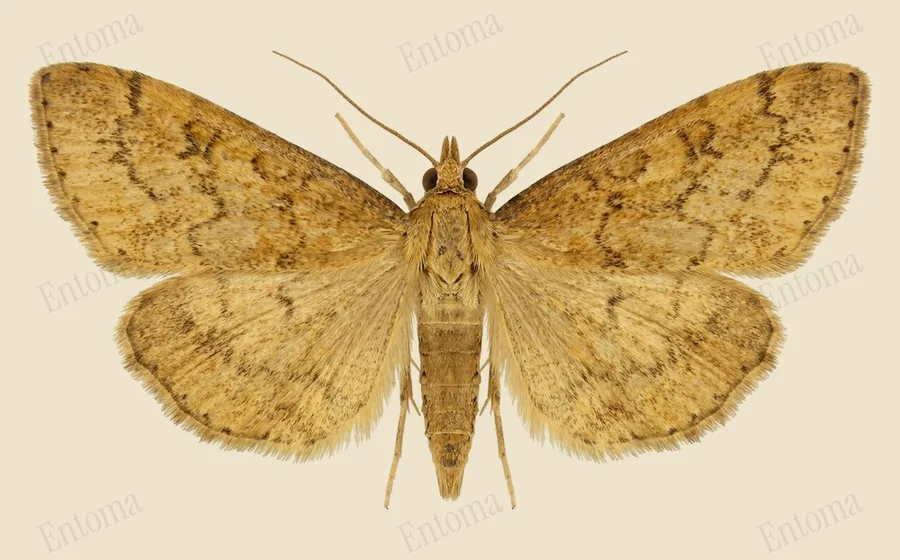
Celery leaftier moth
Its caterpillars tie leaves together with silk to hide while feeding on garden flowers, greenhouse ornamentals, and vegetable crops alike.
| Where | Gardens, greenhouses and vegetable fields |
|---|---|
| Size | 18 to 20 mm wingspan |
| When | February to November |
The Celery leaftier moth is a small tan to reddish brown moth with fine, wavy dark lines crossing the wings, and mouthparts that project forward enough to give it a faintly snouted profile at rest.
Caterpillars are pale greenish yellow with two faint stripes and feed inside shelters made by tying leaves together with silk, damaging celery, lettuce, and many garden and greenhouse ornamentals across North America.
Traits
Habitat
Garden
Colour
Brown
Active
Night
To people
A crop and garden pest rather than a risk to people; the adult moth does not bite or sting.
Activity through the year
Often confused with
Holds its narrower, grayish brown wings tightly against the body in a long slender profile, unlike the broader, more triangular resting shape of the Celery leaftier moth.
Questions
Is the Celery leaftier moth dangerous to people?
A crop and garden pest rather than a risk to people; the adult moth does not bite or sting.
When can you see the Celery leaftier moth?
The Celery leaftier moth can be seen from February to November, at night.
Plate retouched from a photo by Annika Lindqvist, CC BY 4.0, iNaturalist Licence
Report a mistake in this entry
Butterflies and moths›Grass moths›Udea
Last updated 2026-09-26. Every entry is checked against published sources.