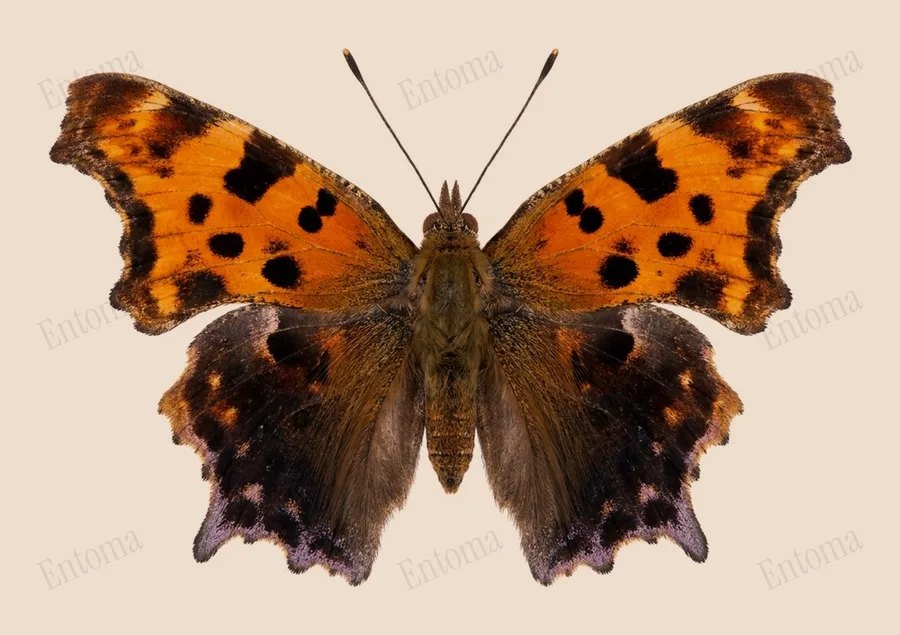
Question mark
Its silvery hindwing mark is a curved line plus a separate dot forming a question mark, while its closest lookalike shows only the curved line.
| Where | Woodland edges, parks and streamsides |
|---|---|
| Size | 45 to 76 mm wingspan |
| When | March to October |
The Question mark has orange and black upperwings with a hooked forewing tip, and mottled brown underwings that resemble a dead leaf when closed. A silvery mark on the underside of the hindwing forms a curved line plus a separate dot, unlike the closely related Eastern comma, which shows only the curved line.
Two generations fly each year, and the late summer brood overwinters as an adult, sheltering in tree cracks or loose bark through the cold months before reappearing in spring to lay eggs on nettles, hackberry and elm.
Traits
Habitat
Woodland
Colour
Orange, Black, Brown
Active
Day
To people
Harmless to people; adults overwinter sheltered in tree cracks or bark rather than migrating away entirely.
Activity through the year
Often confused with
Its silvery hindwing mark is a curved line only, without the extra white dot that completes the Question mark's namesake punctuation shape.
Questions
Is the Question mark dangerous to people?
Harmless to people; adults overwinter sheltered in tree cracks or bark rather than migrating away entirely.
When can you see the Question mark?
The Question mark can be seen from March to October, by day.
Plate retouched from a photo by Andrew Hrycyna, CC BY 4.0, iNaturalist Licence
Report a mistake in this entry
Butterflies and moths›Brush-footed butterflies›Polygonia
Last updated 2026-09-26. Every entry is checked against published sources.