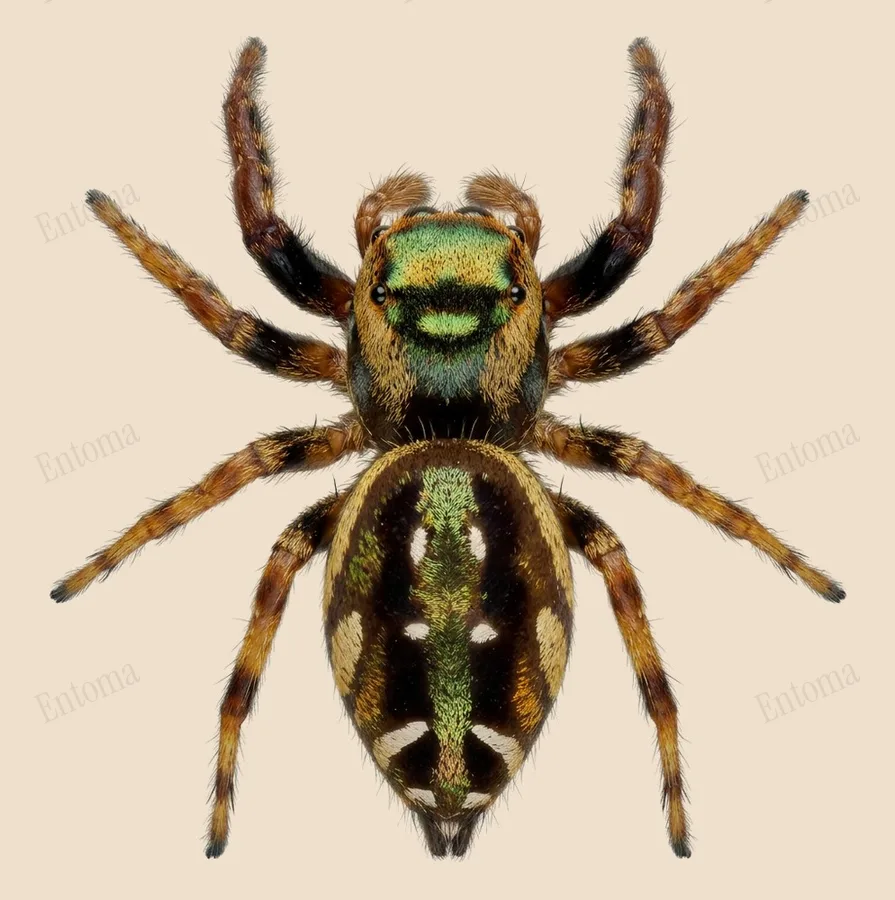
Golden jumping spider
This spider's abdomen flashes between shimmering green and gold as it moves, an effect made by light scattering scales rather than colored pigment.
| Where | Shrubs, trees and gardens |
|---|---|
| Size | Female 9 to 12 mm, male 7 to 10 mm body length |
| When | April to October |
One of the larger jumping spiders in North America, it has a green or black body with white stripes bordering the head, a white bordered abdomen and a pale hairline flanked by white dots and lines down its center. Females run about 9 to 12 mm and males about 7 to 10 mm.
It is a diurnal, visual hunter that stalks insects across leaves on shrubs, trees and tall plants in gardens and orchards, closing the final distance with a sudden jump powered by fluid pressure in its legs rather than muscle.
Traits
Habitat
Garden
Colour
Green, Black, White
Active
Day
To people
This spider very rarely bites, and only if trapped against the skin; any bite is a brief pinprick with mild local stinging that fades within hours, so it is not dangerous to people.
Activity through the year
Often confused with
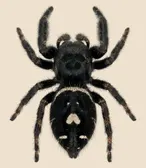
Similar in size and its puffy, hair covered build, but Phidippus species lack the golden jumping spider's white lateral head stripes, white bordered abdomen and pale central hairline flanked by white dots.
Questions
Is the Golden jumping spider dangerous to people?
This spider very rarely bites, and only if trapped against the skin; any bite is a brief pinprick with mild local stinging that fades within hours, so it is not dangerous to people.
When can you see the Golden jumping spider?
The Golden jumping spider can be seen from April to October, by day.
Plate retouched from a photo by Michael, CC BY 4.0, iNaturalist Licence
Report a mistake in this entry
Spiders›Jumping spiders›Paraphidippus
Last updated 2026-09-27. Every entry is checked against published sources.