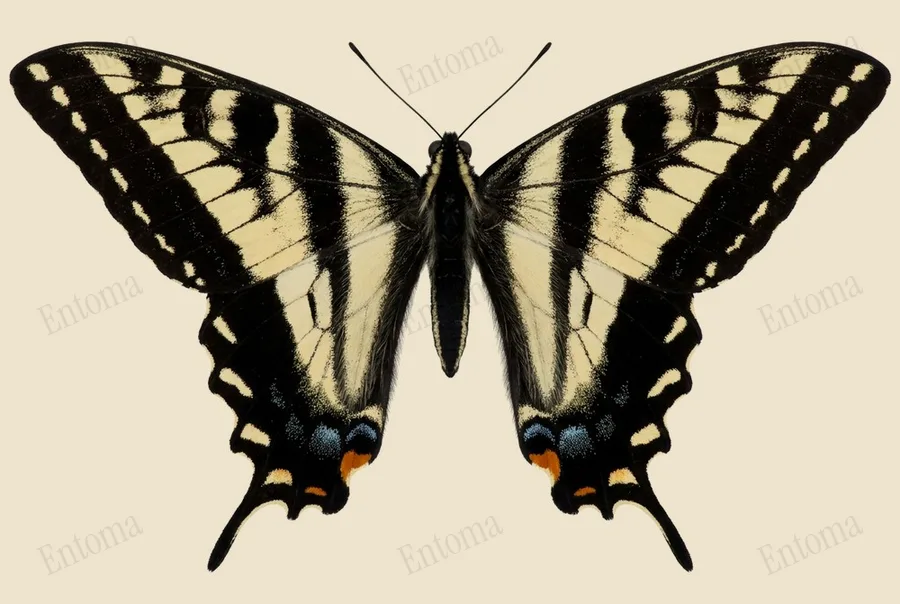
Pale swallowtail
This swallowtail's caterpillars can complete development on redberry, coffeeberry, alder and wild cherry, feeding on plants from three unrelated families rather than just one.
| Where | Forest edges, canyons, foothill woodlands |
|---|---|
| Size | 70 to 90 mm wingspan |
| When | April to August |
The Pale swallowtail is a large butterfly with chalk-white to cream wings crossed by heavy black stripes and bordered in black with pale crescent markings. Long black tails extend from each hindwing, which also carries a small orange spot and a blue patch near the inner corner, and the wingspan runs from about 70 to 90 mm.
Caterpillars feed on shrubs and trees in the rose, buckthorn and birch families, including chokecherry, coffeeberry and alder. A single generation flies through spring and early summer, with a partial second generation appearing in the warmest parts of the range, and the species spends winter as a chrysalis.
Traits
Habitat
Woodland
Colour
White, Black, Yellow
Active
Day
To people
Harmless to people; adults gather at damp sand and mud to drink minerals.
Activity through the year
Often confused with
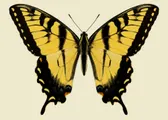
Colored a much deeper yellow with bold black tiger stripes, instead of the pale, almost white to cream ground color of the Pale swallowtail.
Questions
Is the Pale swallowtail dangerous to people?
Harmless to people; adults gather at damp sand and mud to drink minerals.
When can you see the Pale swallowtail?
The Pale swallowtail can be seen from April to August, by day.
Plate retouched from a photo by Christine Laney, CC BY 4.0, iNaturalist Licence
Report a mistake in this entry
Butterflies and moths›Swallowtails›Papilio
Last updated 2026-09-27. Every entry is checked against published sources.