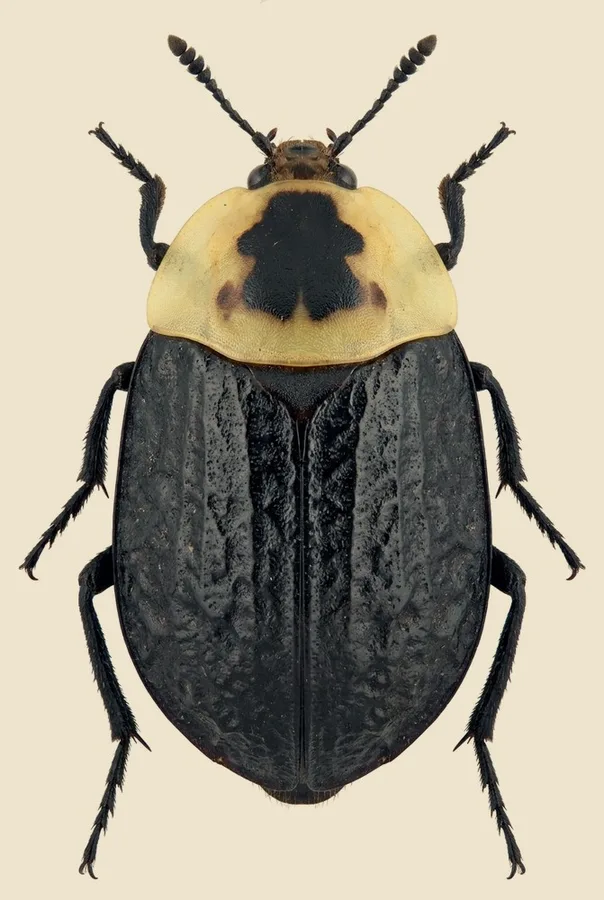
American carrion beetle
This beetle's yellow-and-black pronotum makes it look like a bumblebee in flight, though it heads for compost piles and carcasses instead of flowers.
| Where | Gardens, compost piles and carrion |
|---|---|
| Size | 13 to 20 mm body length |
| When | April to September |
The American carrion beetle has an oval, flattened body with a pale yellow pronotum marked by a large black spot in the center, over black wing covers. Its larvae are dark, teardrop-shaped grubs that look something like sowbugs.
Adults and larvae gather at carrion and rotting matter, where they feed on fly maggots as well as decaying tissue, and mites that ride along on the beetles get an early start on the same fly eggs and larvae once they arrive at a carcass. Females lay their eggs directly on a dead animal after it has begun to dry out.
Traits
Habitat
Garden
Colour
Yellow, Black
Active
Day
To people
Safe to handle; it does not sting or bite people.
Activity through the year
Often confused with
Similar size and habits, but its pronotum is more orange than yellow, the black central mark has a lobe on each side, and it is smaller, reaching only about 12 mm.
Questions
Is the American carrion beetle dangerous to people?
Safe to handle; it does not sting or bite people.
When can you see the American carrion beetle?
The American carrion beetle can be seen from April to September, by day.
Plate retouched from a photo by roundabout1812, CC0, iNaturalist Licence
Report a mistake in this entry
Beetles›Rove beetles›Necrophila
Last updated 2026-09-27. Every entry is checked against published sources.