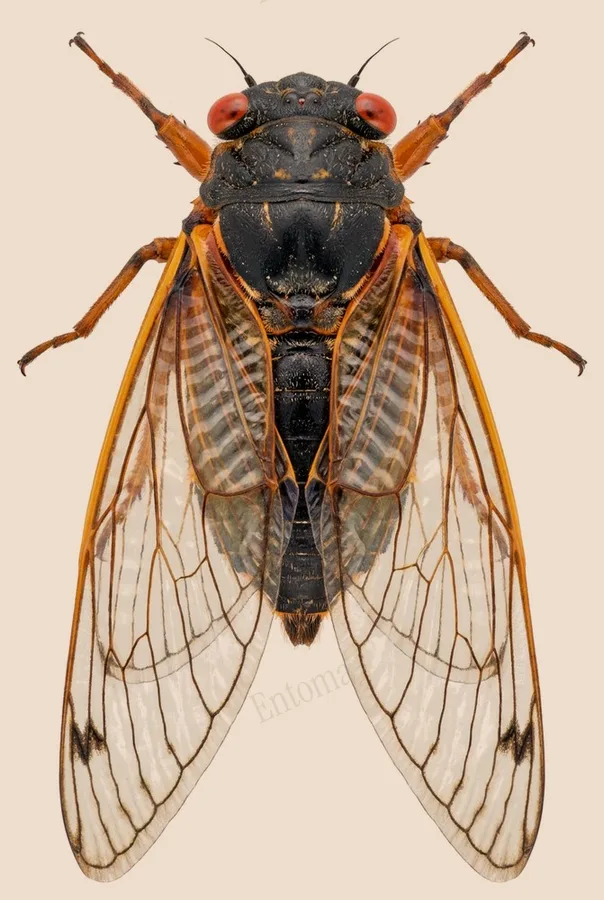
Pharaoh cicada
Its droning call is said to repeat the word Pharaoh, which is how this large periodical cicada earned its common name.
| Where | Deciduous forests and wooded suburbs |
|---|---|
| Size | 35 to 38 mm body length |
| When | May to June |
The Pharaoh cicada has a black body, striking red eyes and red wing veins, with broad orange bands across the underside of the abdomen. It is the largest of the periodical cicadas, reaching about 35 to 38 mm long.
Nymphs spend seventeen years underground feeding on sap from tree roots before emerging together by the millions in May. Adults live only a few weeks, calling and mating in deciduous woodland before dying off by early summer.
Traits
Habitat
Woodland
Colour
Black, Red, Orange
Active
Day
To people
Cannot bite or sting and poses no threat to people, even when emerging by the millions.
Activity through the year
Often confused with
Its body is almost entirely black with little to no orange, unlike the Pharaoh cicada's broad orange bands across the underside of the abdomen.
Questions
Is the Pharaoh cicada dangerous to people?
Cannot bite or sting and poses no threat to people, even when emerging by the millions.
When can you see the Pharaoh cicada?
The Pharaoh cicada can be seen from May to June, by day.
Plate retouched from a photo by Jake McCumber, CC BY 4.0, iNaturalist Licence
Report a mistake in this entry
Last updated 2026-09-27. Every entry is checked against published sources.