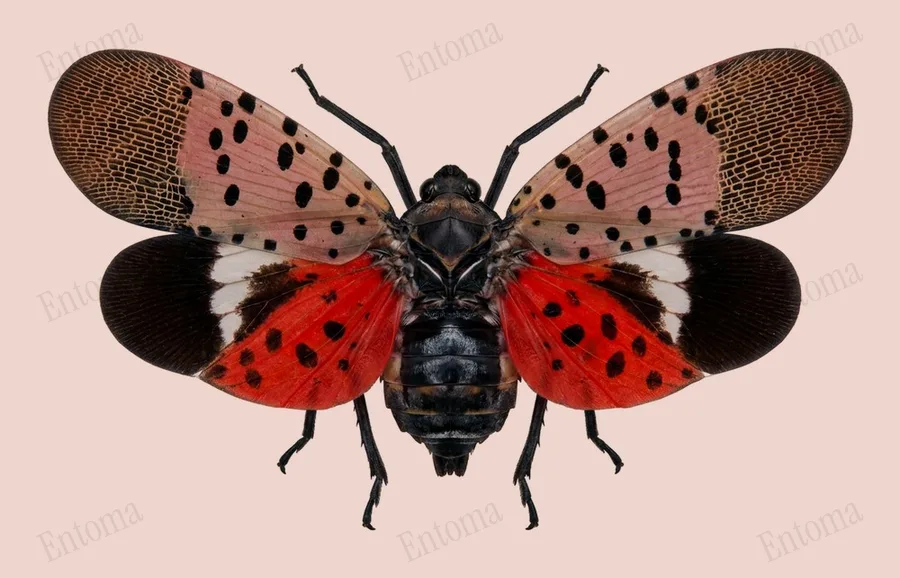
Spotted lanternfly
Spotted lanternflies fly poorly and mostly travel by walking or hopping, but they spread over long distances as egg masses hitchhike on vehicles and outdoor gear.
| Where | Urban trees, orchards and woodlands |
|---|---|
| Size | 20 to 27 mm body length |
| When | May to October |
Adult spotted lanternflies have grey forewings speckled with black spots and folded hindwings that flash red, black and white when the insect is disturbed. The body is black and yellow, and the wings are held tent-like over the back at rest.
Nymphs and adults feed by piercing plant tissue and sucking sap from tree of heaven, grapevines and many other woody plants, weakening the host and fouling surfaces with sticky honeydew. Females lay egg masses on bark and smooth surfaces such as vehicles and outdoor furniture in autumn.
Traits
Habitat
Towns
Colour
Grey, Red, Black
Active
Day and night
To people
Does not bite or sting; harmless to handle, though large numbers can be a nuisance around infested trees.
Activity through the year
Often confused with
Its camouflaged grey and brown forewings also hide bright orange to red hindwings, but the wings lack the spotted lanternfly's black spotting and it lacks a lanternfly's piercing, sucking mouthparts.
Questions
Is the Spotted lanternfly dangerous to people?
Does not bite or sting; harmless to handle, though large numbers can be a nuisance around infested trees.
When can you see the Spotted lanternfly?
The Spotted lanternfly can be seen from May to October, by day and at night.
Plate retouched from a photo by Tyler Ekholm, CC BY 4.0, iNaturalist Licence
Report a mistake in this entry
True bugs›Lanternflies›Lycorma
Last updated 2026-09-26. Every entry is checked against published sources.