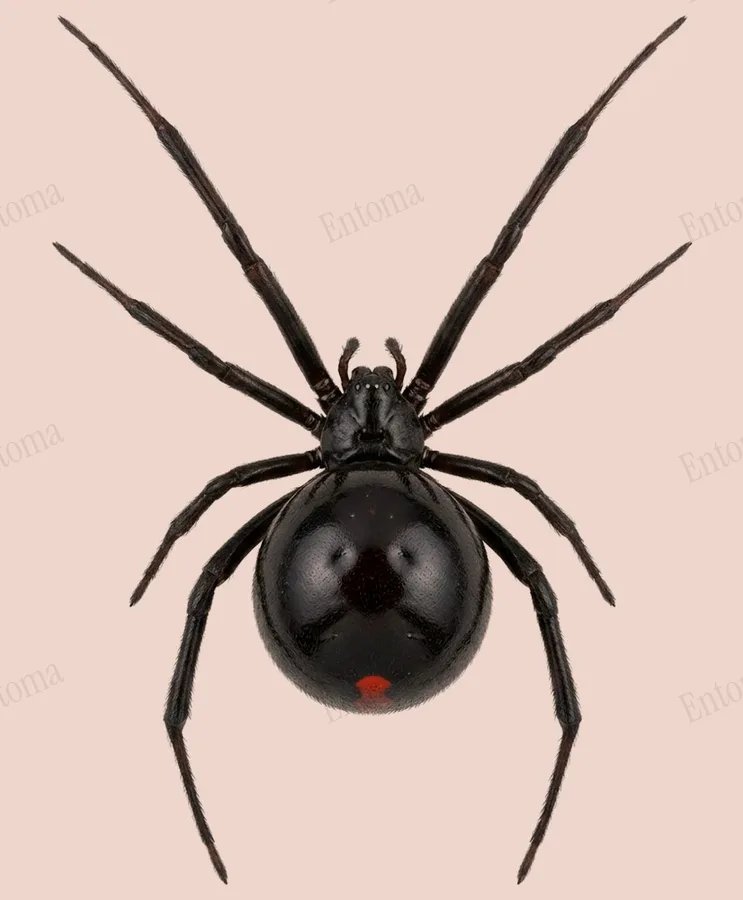
Southern black widow
The red hourglass mark on this spider's underside is one solid shape, while its close northern relative usually carries the same mark broken into two separate triangles.
| Where | Brush piles, logs and outbuildings |
|---|---|
| Size | Female 8 to 13 mm, male 3 to 6 mm body length |
| When | March to November |
The Southern black widow is a glossy black spider with a rounded abdomen and a fully connected red hourglass marking on its underside, sometimes accompanied by a single red spot just behind the spinnerets. The legs are long and slender relative to the body, and males are much smaller and more slender than females, often with pale banding.
Females build a loose, irregular tangle of silk close to the ground in brush piles, hollow logs, crawl spaces and outbuildings, staying hidden by day and resting in the web by night. A single beige egg sac can hold roughly 200 eggs, and adults are most often seen from spring through autumn.
Traits
Habitat
Farmland
Colour
Black, Red
Active
Night
To people
Dangerous
Bites are uncommon and happen mainly in self defense, but the venom can cause severe muscle pain, cramping and high blood pressure; washing the bite and getting medical care is recommended if symptoms are more than mild.
Activity through the year
Often confused with
The red hourglass mark on the underside is broken into two separated triangles rather than joined, and a row of red spots often runs down the middle of the back.
Questions
Is the Southern black widow dangerous to people?
Dangerous. Bites are uncommon and happen mainly in self defense, but the venom can cause severe muscle pain, cramping and high blood pressure; washing the bite and getting medical care is recommended if symptoms are more than mild.
When can you see the Southern black widow?
The Southern black widow can be seen from March to November, at night.
Plate retouched from a photo by Jaime González, CC BY 4.0, iNaturalist Licence
Report a mistake in this entry
Spiders›Cobweb spiders›Latrodectus
Last updated 2026-09-27. Every entry is checked against published sources.