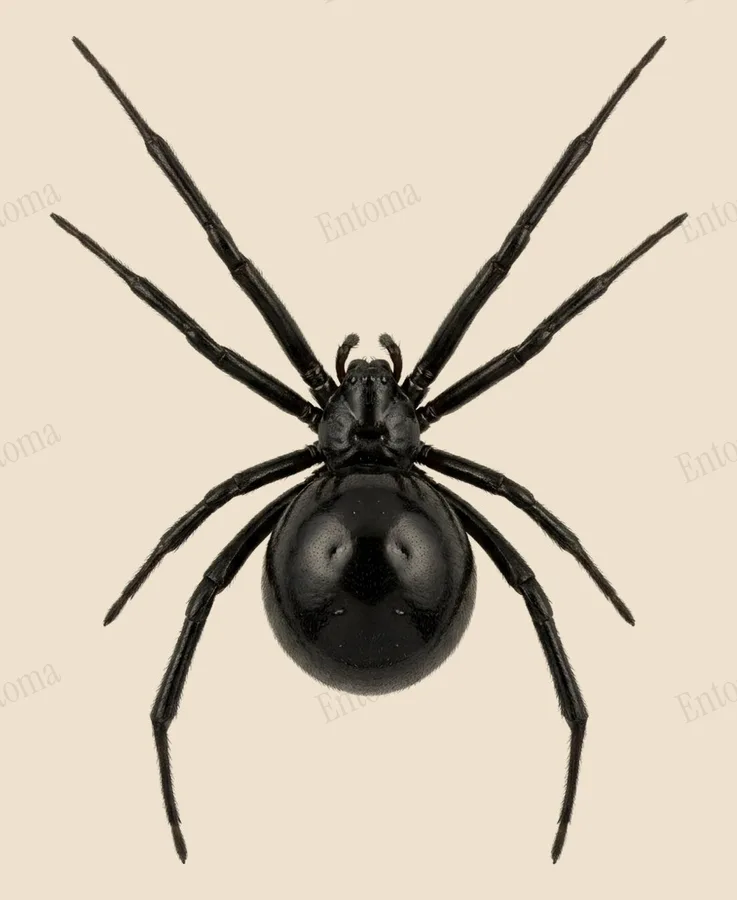
Western black widow
A bite from this shy spider is rarely felt at first, yet its venom can bring on muscle cramping and heavy sweating far from the actual bite site.
| Where | Woodpiles, sheds and building foundations |
|---|---|
| Size | Female 14 to 16 mm, male 6 to 8 mm body length |
| When | March to November |
The Western black widow is a shiny, rounded black spider with a red hourglass mark on the underside of its abdomen, though the mark can be broken or reduced in some individuals. Legs are long and thin compared with the bulbous body, and the whole animal is far smaller and more delicate looking than its reputation suggests.
Females spend the day hidden in a silken retreat at the edge of a loose, irregular tangle of threads, emerging mainly after dark to wrap and feed on insects caught in the snare. Webs are usually built low to the ground in woodpiles, water meters, garages and other undisturbed corners near buildings.
Traits
Habitat
Towns
Colour
Black, Red
Active
Night
To people
Dangerous
Bites are uncommon and defensive, but the venom can cause severe cramping, sweating and nausea spreading from the bite; anyone bitten should wash the area and seek medical care if symptoms spread.
Activity through the year
Often confused with
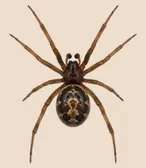
A uniformly dark purplish brown to black, bulbous abdomen with faint pale markings but no red hourglass on the underside, unlike the Western black widow.
Questions
Is the Western black widow dangerous to people?
Dangerous. Bites are uncommon and defensive, but the venom can cause severe cramping, sweating and nausea spreading from the bite; anyone bitten should wash the area and seek medical care if symptoms spread.
When can you see the Western black widow?
The Western black widow can be seen from March to November, at night.
Plate retouched from a photo by Andrew Meeds, CC BY 4.0, iNaturalist Licence
Report a mistake in this entry
Spiders›Cobweb spiders›Latrodectus
Last updated 2026-09-27. Every entry is checked against published sources.