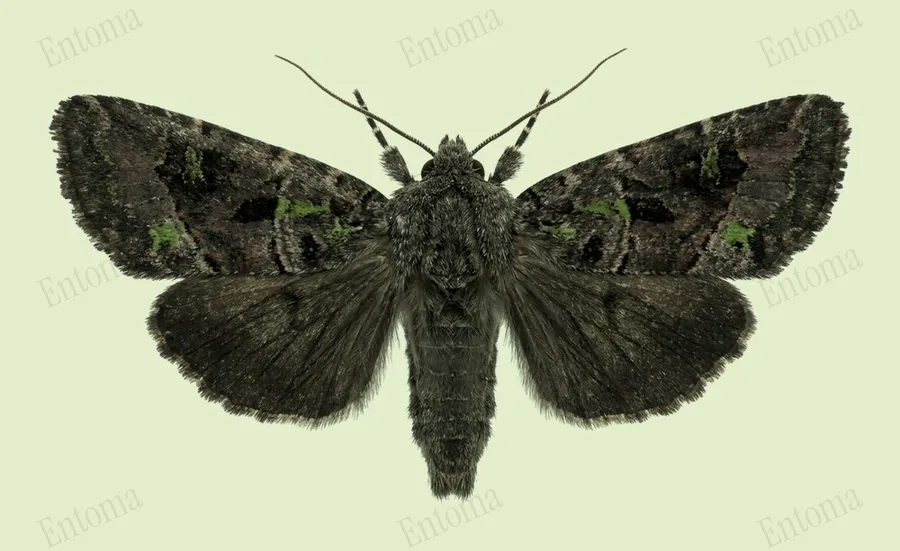
Bristly cutworm moth
Also called the kidney-spotted minor, its caterpillars feed on cabbage, lettuce and corn yet cause so little damage they are barely considered a pest.
| Where | Fields, gardens and open ground |
|---|---|
| Size | 21 to 30 mm wingspan |
| When | May to September |
The Bristly cutworm moth has dark greyish-brown forewings marked with three green spots, one edged in white, and pale grey hindwings that darken toward the margin; its wingspan runs about 21 to 30 mm.
Caterpillars feed on a wide range of herbaceous plants and occasional garden crops including cabbage, lettuce and corn, and two broods fly each year from late spring into early autumn.
Traits
Habitat
Grassland
Colour
Brown, Green, Grey
Active
Night
To people
Attracted to light; harmless to people.
Activity through the year
Often confused with
Has light green forewings with one large brown patch in the center, quite different from the Bristly cutworm moth's three small green spots, one white-bordered, on a dark greyish-brown background.
Questions
Is the Bristly cutworm moth dangerous to people?
Attracted to light; harmless to people.
When can you see the Bristly cutworm moth?
The Bristly cutworm moth can be seen from May to September, at night.
Plate retouched from a photo by meaningful_name, CC0, iNaturalist Licence
Report a mistake in this entry
Butterflies and moths›Owlet moths›Lacinipolia
Last updated 2026-09-27. Every entry is checked against published sources.