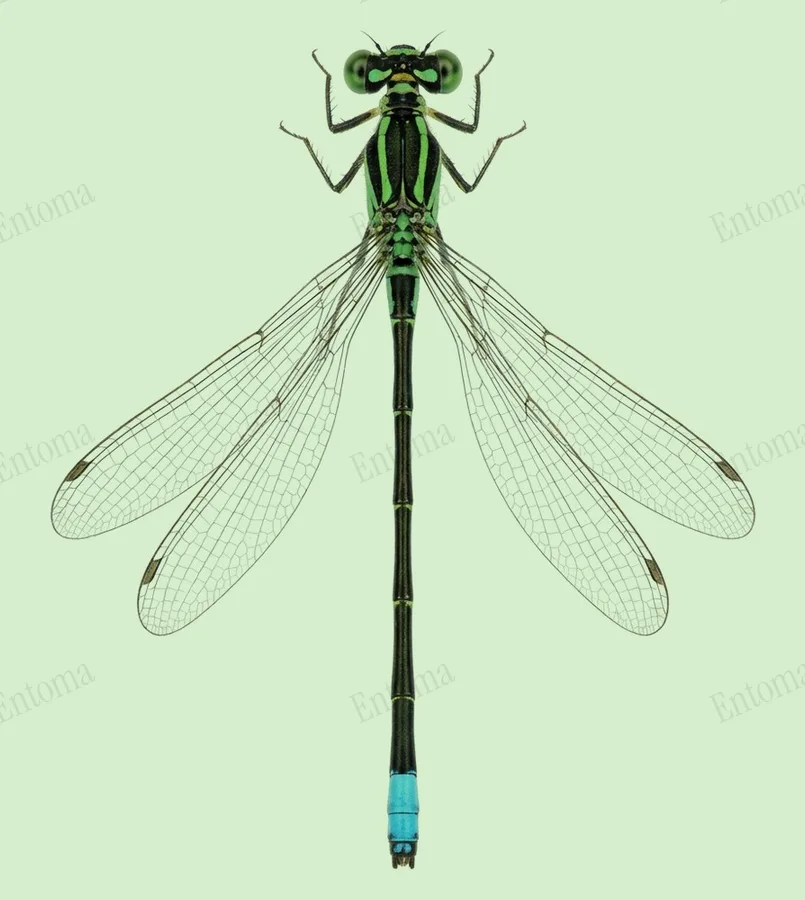
Rambur's forktail
Rambur's forktail is small enough to fit on a fingernail, yet females hunt insects as large as themselves, including other damselflies.
| Where | Ponds, marshes and slow streams |
|---|---|
| Size | 25 to 36 mm body length |
| When | February to November |
Rambur's forktail is a slender damselfly. Males have green eyes capped in black, a sky-blue lower thorax and a mostly green body with blue near the tip of the abdomen. Females are more variable, appearing orange when young, dull olive-green with age, or blue like males in a third color form.
It lives among emergent plants at the edges of ponds, marshes and slow streams, where it hunts small flying insects. It is an active, direct predator for its size, and mating pairs can stay joined together on waterside vegetation for hours.
Traits
Habitat
Wetland
Colour
Green, Blue, Orange
Active
Day
To people
Safe to handle; it does not sting or bite people.
Activity through the year
Often confused with
Smaller and more yellow-green overall, with black spearhead markings down the top of the abdomen, rather than the mostly green and blue tones of Rambur's forktail.
Questions
Is the Rambur's forktail dangerous to people?
Safe to handle; it does not sting or bite people.
When can you see the Rambur's forktail?
The Rambur's forktail can be seen from February to November, by day.
Plate retouched from a photo by dhasdf, CC BY 4.0, iNaturalist Licence
Report a mistake in this entry
Dragonflies and damselflies›Narrow-winged damselflies›Ischnura
Last updated 2026-09-27. Every entry is checked against published sources.