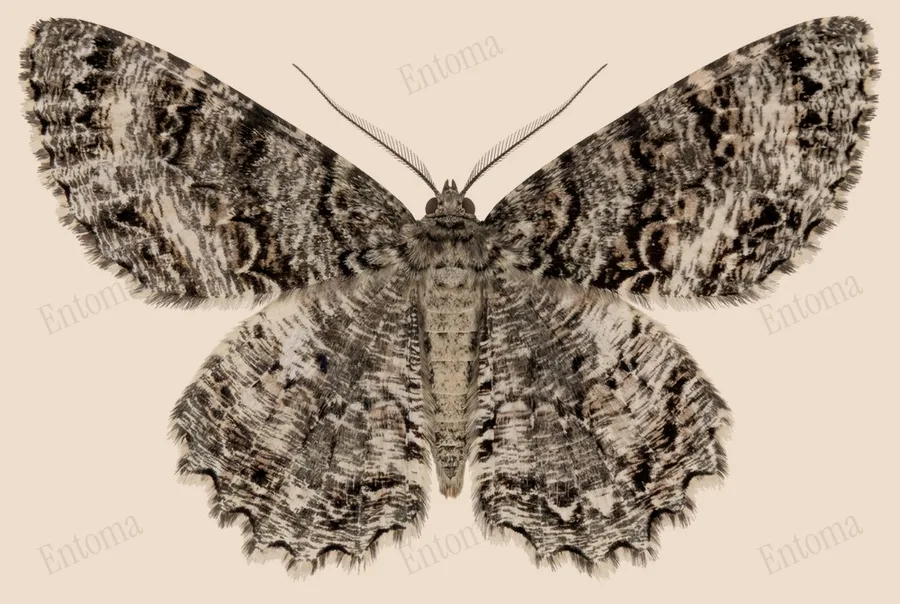
Tulip-tree beauty
This large geometer moth rests flat against bark with its wings fully spread, and some individuals turn an unusual, almost blackish form.
| Where | Woodlands and forest edges |
|---|---|
| Size | 43 to 56 mm wingspan |
| When | March to August |
The Tulip-tree beauty is a large grey to brown moth with a wingspan of about 43 to 56 mm, its wings crossed by dark wavy lines and finished with scalloped edges that break up its outline against tree bark. It rests with wings spread flat, and while most are pale and patterned, some individuals appear in a darker, almost blackish form.
Caterpillars feed on the leaves of tulip tree, sassafras, magnolia and pawpaw, growing into thick-bodied larvae with a swollen segment behind the head. Adults fly from spring into late summer across the eastern half of North America and come readily to lights at night.
Traits
Habitat
Woodland
Colour
Grey, Brown, White
Active
Night
To people
Attracted to light; harmless to people.
Activity through the year
Often confused with
Smaller than the Tulip-tree beauty and marked with two conspicuous wavy lines across the forewing, a pattern the Tulip-tree beauty lacks.
Questions
Is the Tulip-tree beauty dangerous to people?
Attracted to light; harmless to people.
When can you see the Tulip-tree beauty?
The Tulip-tree beauty can be seen from March to August, at night.
Plate retouched from a photo by Ray Fisher, CC BY 4.0, iNaturalist Licence
Report a mistake in this entry
Butterflies and moths›Geometer moths›Epimecis
Last updated 2026-09-27. Every entry is checked against published sources.