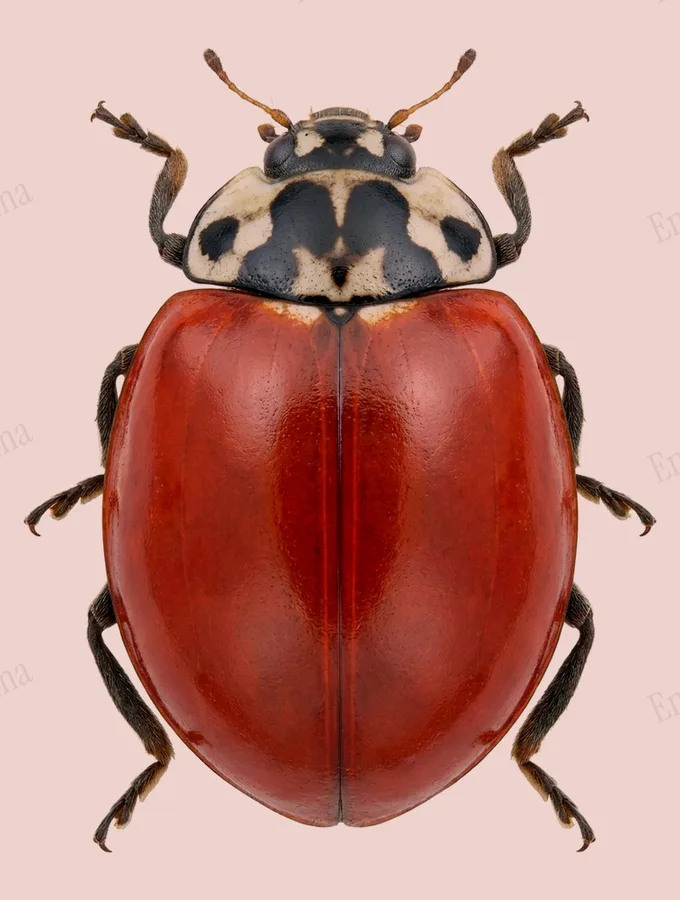
Spotless lady beetle
Unlike most lady beetles, adults of this species carry no spots on their glossy orange-red wing covers, making the plain color itself the identifying clue.
| Where | Gardens, crop fields, open vegetation |
|---|---|
| Size | 4 to 6.5 mm body length |
| When | February to November |
The spotless lady beetle has smooth, shiny wing covers ranging from orange to deep red with no spots, aside from a pale mark sometimes visible just behind the thorax. Each side of the black thorax carries an isolated pale yellow or white spot fully ringed by black, and the body is domed like other lady beetles, measuring about 4 to 6.5 mm long.
Both the larvae and adults hunt aphids and other soft-bodied insects, with a single adult female consuming roughly 300 aphids over her lifetime and each larva eating hundreds more as it develops. Several generations are produced each year in gardens, crop fields and wild vegetation wherever aphids are abundant.
Traits
Habitat
Garden
Colour
Orange, Red, Black
Active
Day
To people
Harmless to people; adults and larvae feed only on aphids and other soft-bodied insects.
Activity through the year
Often confused with
Carries a similarly shiny orange-red wing cover, but the pale mark on each side of its black thorax forms a C shape or a full ring instead of the isolated spot fully surrounded by black seen in the Spotless lady beetle.
Questions
Is the Spotless lady beetle dangerous to people?
Harmless to people; adults and larvae feed only on aphids and other soft-bodied insects.
When can you see the Spotless lady beetle?
The Spotless lady beetle can be seen from February to November, by day.
Plate retouched from a photo by Clarity Shimoniak, CC BY‑SA 4.0, iNaturalist Licence
The plate on this page is shared under the same licence as its source, CC BY-SA.
Report a mistake in this entry
Last updated 2026-09-27. Every entry is checked against published sources.