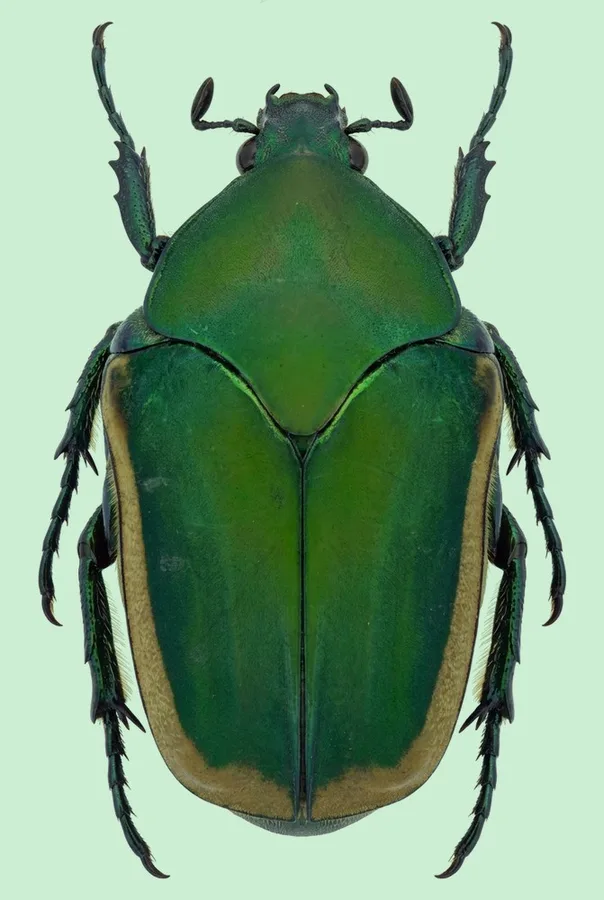
Figeater beetle
The grub of this beetle crawls on its back instead of its legs, using rows of stiff bristles to push itself along, earning the nickname back crawler.
| Where | Gardens, orchards and compost piles |
|---|---|
| Size | 19 to 34 mm body length |
| When | June to October |
The Figeater beetle is a large scarab beetle up to about 34 mm long, dull metallic green above with tan to brown margins on the wing covers and a short, horn-like bump on the face. The underside gleams with a brighter metallic shine than the matte top of the beetle.
Grubs live in compost, mulch, manure and other rotting plant matter for about a year, feeding on the decaying material rather than on living roots. Adults fly by day in warm months, feeding on nectar and soft ripe fruit such as figs, peaches and grapes, and occasionally damaging garden crops in the process.
Traits
Habitat
Garden
Colour
Green, Brown, Metallic
Active
Day
To people
Harmless to people; adults may swarm around ripe fruit but do not sting or bite.
Activity through the year
Often confused with
A similar metallic green scarab found further east, but smaller and more uniformly bright green, without the broad tan-brown wing-cover margins of the Figeater beetle.
A smaller flower-visiting scarab that is dark brown to black rather than the dull metallic green of the Figeater beetle.
Questions
Is the Figeater beetle dangerous to people?
Harmless to people; adults may swarm around ripe fruit but do not sting or bite.
When can you see the Figeater beetle?
The Figeater beetle can be seen from June to October, by day.
Plate retouched from a photo by ingorenner, CC0, iNaturalist Licence
Report a mistake in this entry
Last updated 2026-09-27. Every entry is checked against published sources.