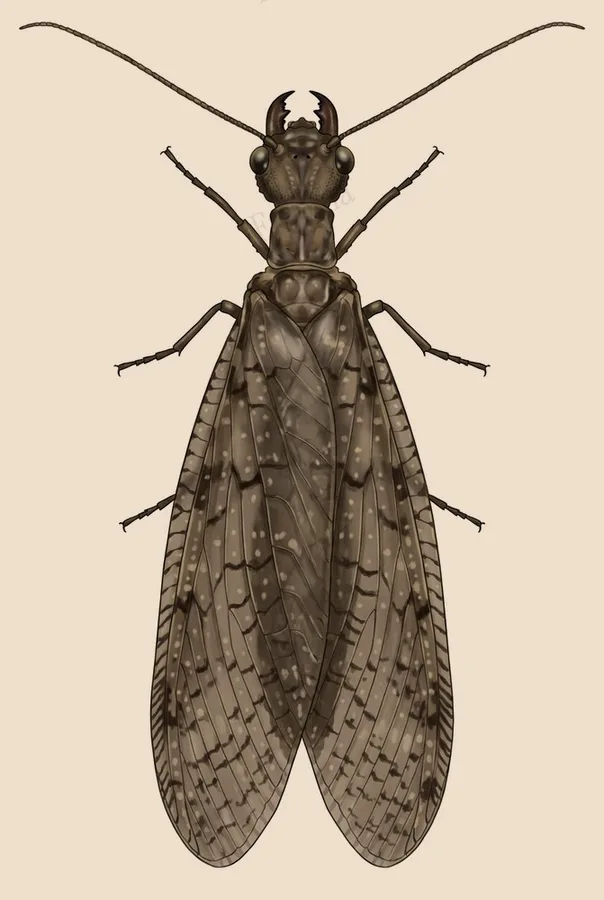
Eastern dobsonfly
Male eastern dobsonflies grow long, tusk-like mandibles too weak to pinch, while females, with much shorter jaws, can bite hard enough to draw blood.
| Where | Fast streams and rivers across North America |
|---|---|
| Size | 90 to 140 mm long (body length) |
| When | April to October |
The Eastern dobsonfly is one of the largest insects in North America, with a body length of 90 to 140 mm. Males have long, sickle-shaped mandibles used in courtship contests, while females have much shorter, more powerful jaws. Adults are soft-bodied and grey, black or brown, with large wings folded along the body at rest.
Larvae, known as hellgrammites, live under rocks in swift-flowing streams and rivers for one to three years, hunting other aquatic insects. Adults emerge in late spring and early summer, rarely feed, and live only a matter of days before mating and dying.
Traits
Habitat
Wetland
Colour
Brown, Black, Grey
Active
Night
To people
Mild
Females can give a painful bite if handled, but bites are rare and not dangerous.
Activity through the year
Often confused with
A much smaller relative at about 22 to 28 mm long, lacking the eastern dobsonfly's huge size and the male's long tusk-like mandibles.
Questions
Is the Eastern dobsonfly dangerous to people?
Mild. Females can give a painful bite if handled, but bites are rare and not dangerous.
When can you see the Eastern dobsonfly?
The Eastern dobsonfly can be seen from April to October, at night.
Plate retouched from a photo by Ryan Kurtz, CC BY 4.0, iNaturalist Licence
Report a mistake in this entry
Dobsonflies and alderflies›Dobsonflies and fishflies›Corydalus
Last updated 2026-09-27. Every entry is checked against published sources.