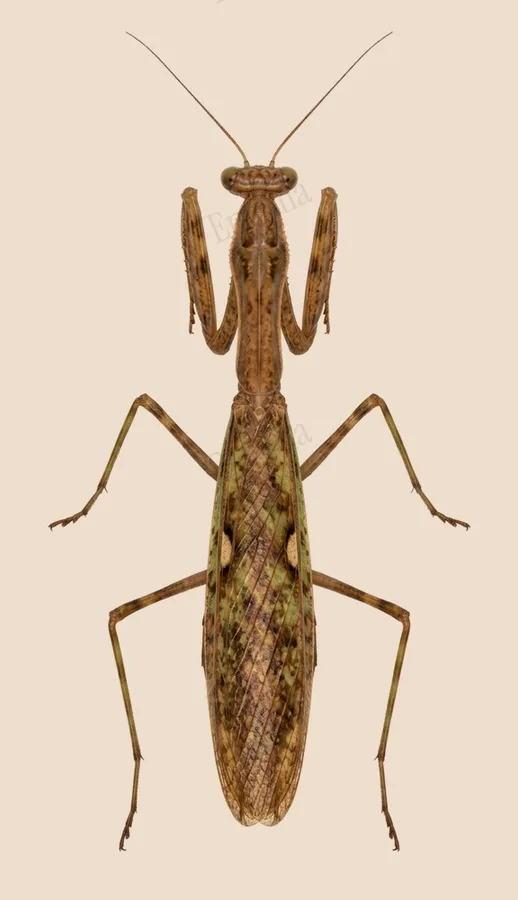
Asian jumping mantis
Despite its name, this mantis usually escapes danger by dropping to the ground or dashing away rather than jumping.
| Where | Grassland, farmland edges and low hills |
|---|---|
| Size | 40 to 58 mm body length |
| When | July to November |
Most individuals are brown to dark brown and blend closely with dry grass and fallen leaves, though green individuals occur occasionally. A dark patch on the inner surface of the raptorial forelegs can be seen when the mantis is feeding or handling prey.
This species hunts from a motionless ambush position in grassland, farmland edges and other semi-open ground from lowlands to low hills, rather than in dense forest. Its camouflage works especially well in autumn, when dry brown vegetation matches its coloring closely.
Traits
Habitat
Grassland
Colour
Brown
Active
Day
To people
Not known to sting or bite people; when threatened it flees or drops away rather than defending itself.
Activity through the year
Often confused with
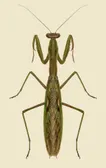
Much larger and typically green or pale brown, with a bright orange spot between the front legs used in threat displays, which the Asian jumping mantis lacks.
Questions
Is the Asian jumping mantis dangerous to people?
Not known to sting or bite people; when threatened it flees or drops away rather than defending itself.
When can you see the Asian jumping mantis?
The Asian jumping mantis can be seen from July to November, by day.
Plate retouched from a museum specimen photo by Natural History Museum, CC0, GBIF Licence
Report a mistake in this entry
Last updated 2026-09-27. Every entry is checked against published sources.