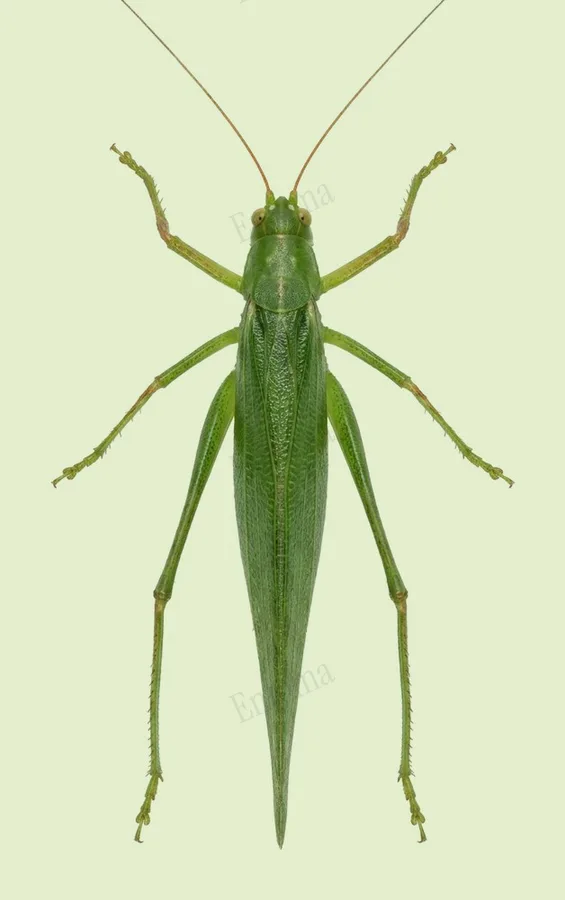
Sinochlora longifissa
Males call at night by rubbing their wings together, and reddish front leg segments set them apart from a near identical relative.
| Where | Broadleaf forests and forest edges |
|---|---|
| Size | 45 to 62 mm body length |
| When | July to October |
This is a large, mostly green katydid with brownish forewings and a reddish tinge on the femurs of its front legs, a feature that separates it from a very similar species sharing the same forests.
Nymphs feed on the leaves of broadleaf trees through summer before maturing into adults that remain active into autumn, living in forest canopies and along forest edges where males sing to attract mates.
Traits
Habitat
Woodland
Colour
Green, Brown
Active
Night
To people
Well camouflaged among leaves and rarely encountered; calm to observe from a short distance.
Activity through the year
Often confused with
Very similar in size and shape, but its front leg femurs lack the reddish tinge that marks this species.
Questions
Is Sinochlora longifissa dangerous to people?
Well camouflaged among leaves and rarely encountered; calm to observe from a short distance.
When can you see Sinochlora longifissa?
Sinochlora longifissa can be seen from July to October, at night.
Plate retouched from a photo by Takaaki Hattori, CC BY 4.0, iNaturalist Licence
Report a mistake in this entry
Crickets and grasshoppers›Bush crickets›Sinochlora
Last updated 2026-09-27. Every entry is checked against published sources.