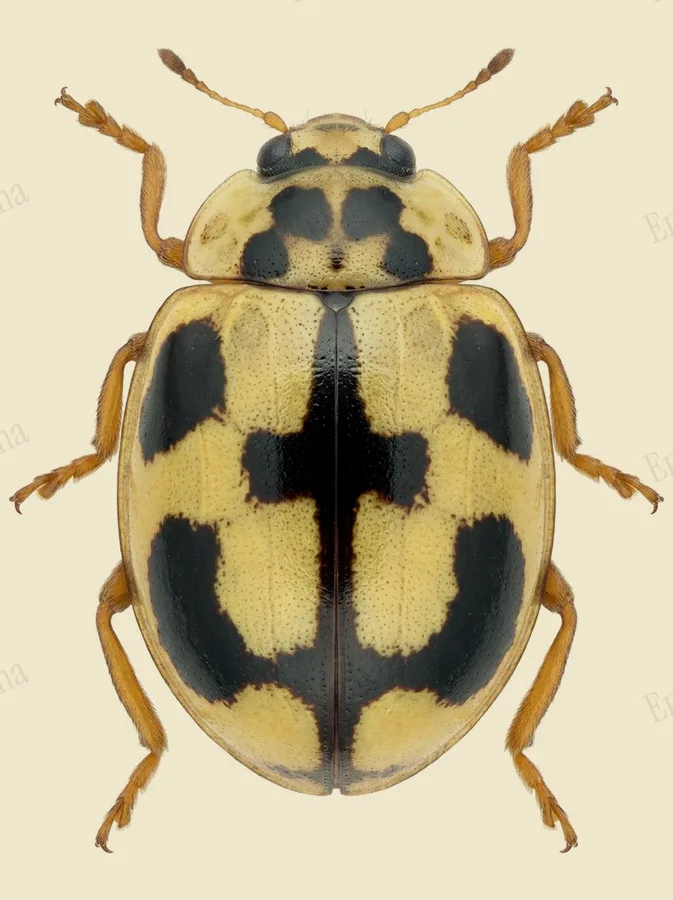
Turtle vein lady beetle
Barely the size of a rice grain, this ladybird beetle is reared commercially and released onto crops across East Asia to eat aphids.
| Where | Crops and gardens, East Asia |
|---|---|
| Size | 3.0 to 4.7 mm body length |
| When | April to October |
A small, elongated oval ladybird with a pale creamy yellow ground colour, a black band across the middle of the pronotum, and variable dark markings on the wing covers.
Both adults and larvae hunt aphids on crops and other plants, making it a widely used biological control agent, with adults active from early spring through to autumn across its range.
Traits
Habitat
Farmland
Colour
Yellow, Black
Active
Day
To people
Harmless to people; it neither bites nor stings and is valued for eating crop pests.
Activity through the year
Often confused with
A close relative with a broader, more rounded body and squarer pale shoulder spots, compared to the narrower body and more oblong spots of this species.
Questions
Is the Turtle vein lady beetle dangerous to people?
Harmless to people; it neither bites nor stings and is valued for eating crop pests.
When can you see the Turtle vein lady beetle?
The Turtle vein lady beetle can be seen from April to October, by day.
Plate retouched from a photo by Zinogre, CC BY‑SA 4.0, iNaturalist Licence
The plate on this page is shared under the same licence as its source, CC BY-SA.
Report a mistake in this entry
Last updated 2026-09-27. Every entry is checked against published sources.