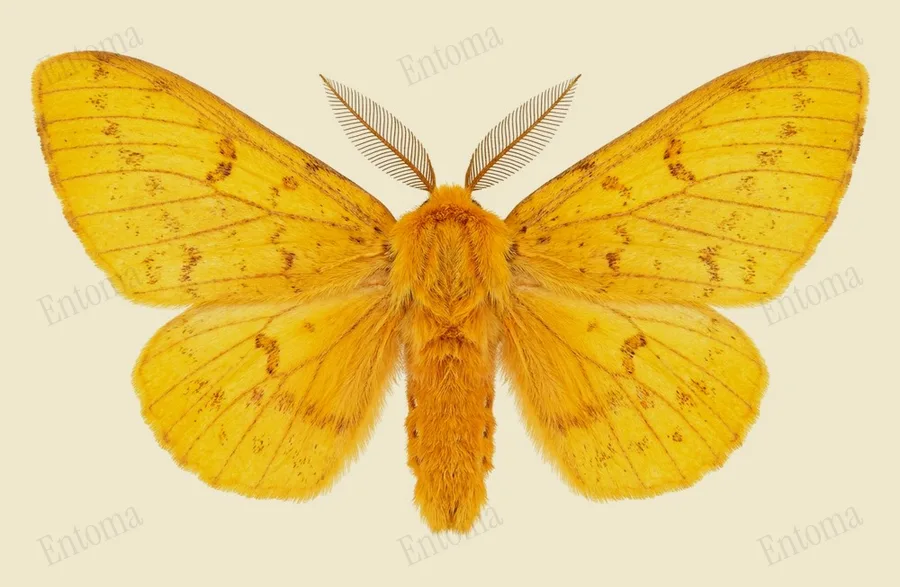
Banyan tussock moth
Newly emerged males lose most of the scales from their forewings within hours, leaving them almost completely transparent, while females stay solid milky white.
| Where | Fig trees in towns and forests |
|---|---|
| Size | 25 to 50 mm wingspan |
| When | October to July |
Adult banyan tussock moths are strongly sexually dimorphic: males are grey black with forewings that turn transparent soon after emergence and a wingspan of 25 to 38 mm, while females are milky white all over with a wingspan of 30 to 50 mm. Both sexes have feathery antennae and a stout, hairy body.
Caterpillars feed in groups on the leaves of banyan and other fig trees, sometimes stripping them bare during outbreaks, and their long hairs remain embedded in the silk cocoons spun on leaves before the moth emerges.
Traits
Habitat
Towns
Colour
White, Black, Brown
Active
Night
To people
Take care
Caterpillar hairs can irritate skin and eyes on contact, and adults do not bite or sting.
Activity through the year
Often confused with
A much larger forest pest with obvious black bands across patterned grey brown forewings and reddish scales on the neck, unlike the plain transparent or milky white wings of the banyan tussock moth.
Questions
Is the Banyan tussock moth dangerous to people?
Take care. Caterpillar hairs can irritate skin and eyes on contact, and adults do not bite or sting.
When can you see the Banyan tussock moth?
The Banyan tussock moth can be seen from October to July, at night.
Plate retouched from a museum specimen photo by Taiwan Biodiversity Research Institute, CC BY 4.0, GBIF Licence
Report a mistake in this entry
Butterflies and moths›Erebid moths›Perina
Last updated 2026-09-27. Every entry is checked against published sources.