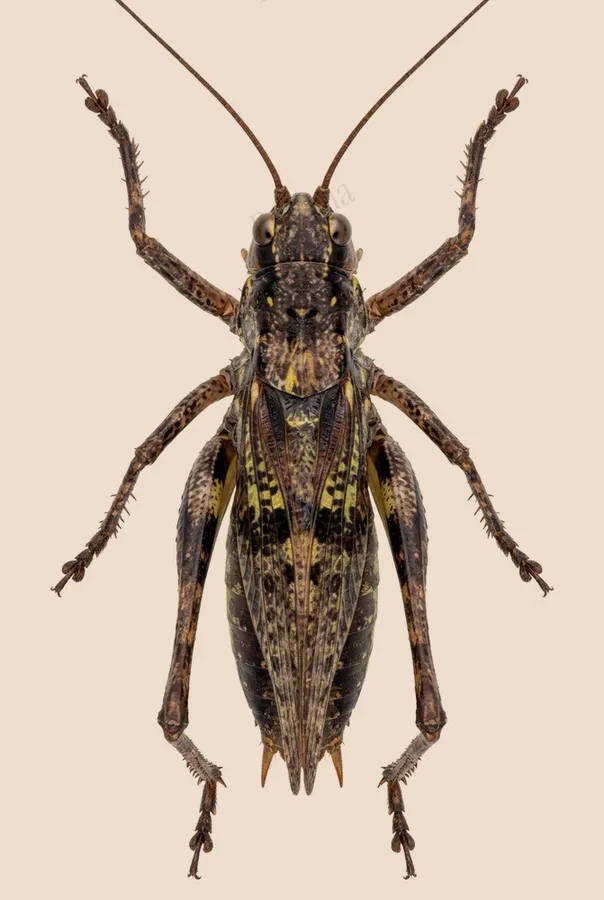
Ussur brown katydid
This katydid moves from oak covered hillsides into orchards as a nymph, and its sharp jaws can bite the skin of people who catch it bare handed.
| Where | Wooded hillsides and orchards, East Asia |
|---|---|
| Size | 25 to 40 mm body length |
| When | April to September |
The Ussur brown katydid is a heavy bodied, dark brown to blackish insect with short wings that leave it unable to fly, bright green sides, a yellowish underside and reddish yellow tones toward the rear of the body.
Nymphs hatch in early spring and feed on oak leaves on wooded hillsides, then move down into orchards as they grow, feeding on peach and other fruit trees before adults return uphill in summer to lay eggs in the soil.
Traits
Habitat
Woodland
Colour
Brown, Black, Green
Active
Day
To people
Take care
Can bite defensively with sharp jaws if handled bare handed; caution is advised when catching it.
Activity through the year
Often confused with
Occurs in both a short winged form about 19 to 25 mm long and a fully winged migratory form up to 35 mm, unlike the Ussur brown katydid, which is always short winged and unable to fly.
Questions
Is the Ussur brown katydid dangerous to people?
Take care. Can bite defensively with sharp jaws if handled bare handed; caution is advised when catching it.
When can you see the Ussur brown katydid?
The Ussur brown katydid can be seen from April to September, by day.
Plate retouched from a photo by mister_bumble, CC BY 4.0, iNaturalist Licence
Report a mistake in this entry
Crickets and grasshoppers›Bush crickets›Paratlanticus
Last updated 2026-09-27. Every entry is checked against published sources.