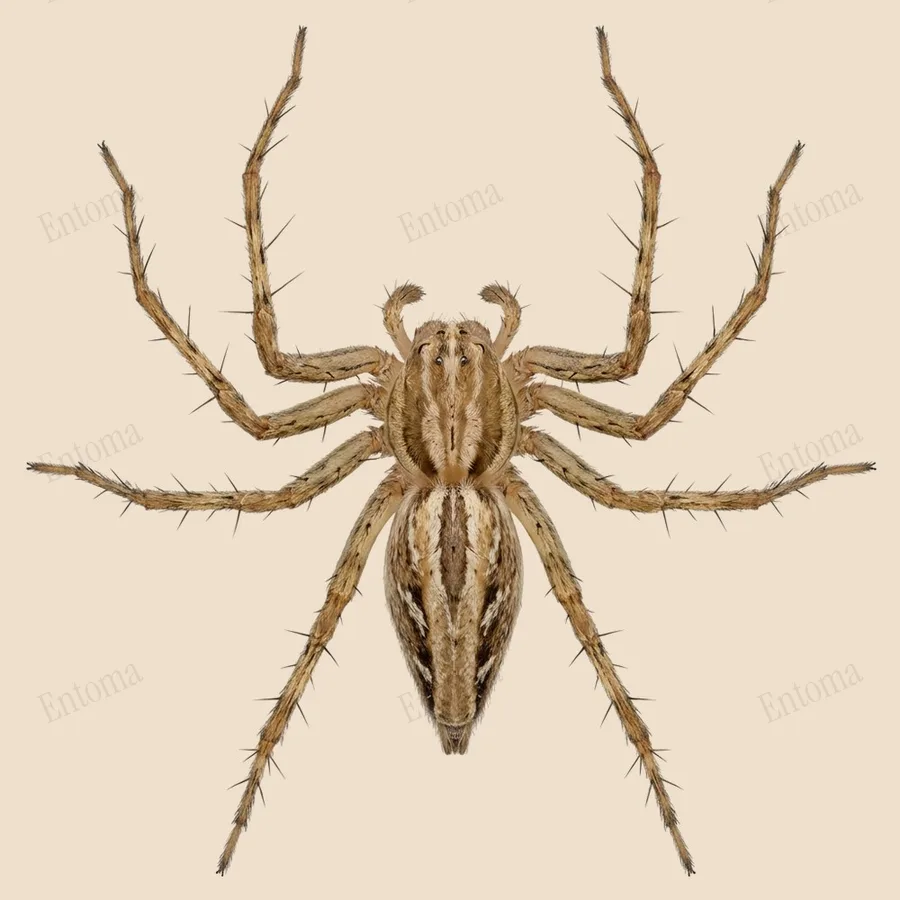
Oxyopes sertatus
In 1961, tens of thousands of these lynx spiders were released into a cedar forest and cut damage from a pest gall midge by more than half.
| Where | Forests and shrubland across East Asia |
|---|---|
| Size | Female 7 to 11 mm, male about 9 mm body length |
| When | January to November |
The carapace is pale brownish, sometimes greenish in life, with a deep black spot behind each of the six upper eyes; the yellowish white abdomen carries a broad brown to gray central stripe and diagonal dark lines along the sides, and the long legs bear strong spines.
It hunts actively on foliage across forests and shrubland instead of building a web, and in 1961 tens of thousands were released into a cedar forest to fight a pest gall midge, cutting the damage it caused by more than half.
Traits
Habitat
Woodland
Colour
Green, Yellow, Brown
Active
Day and night
To people
Not dangerous to people; like other lynx spiders it hunts small insects on foliage rather than approaching humans.
Activity through the year
Often confused with
This lynx spider has a noticeably slimmer body, about four times as long as it is wide, marked with black, orange and white lines, unlike the stockier, spot-marked body of Oxyopes sertatus.
Questions
Is Oxyopes sertatus dangerous to people?
Not dangerous to people; like other lynx spiders it hunts small insects on foliage rather than approaching humans.
When can you see Oxyopes sertatus?
Oxyopes sertatus can be seen from January to November, by day and at night.
Plate retouched from a photo by 雲一百香果, CC BY 4.0, iNaturalist Licence
Report a mistake in this entry
Last updated 2026-09-27. Every entry is checked against published sources.