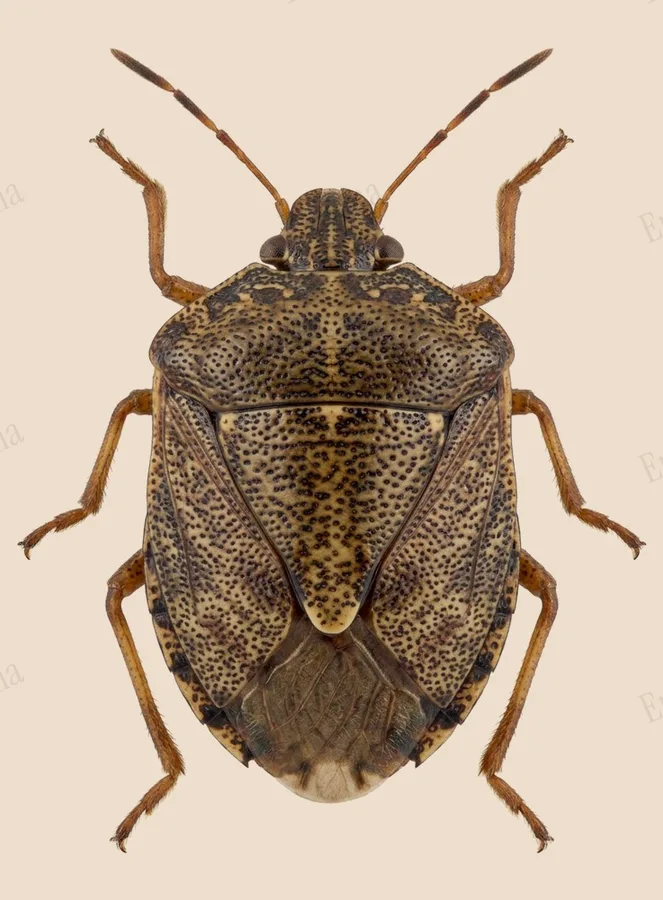
Japanese common plataspid stinkbug
When crushed or brushed against skin, this small round bug's defensive fluid can cause a burning sensation and leave a reddish welt on bare skin.
| Where | Legume fields, gardens and building walls |
|---|---|
| Size | 3 to 5 mm body length |
| When | April to November |
This is a small, strongly rounded bug with a flattened rear end and a dull brown body marked with darker punctures. An oversized scutellum covers almost the whole abdomen, giving it a domed, turtle-like shape rather than the flatter shield shape of most true bugs.
It feeds on soybean, kudzu and other legumes, and releases a foul-smelling defensive fluid when disturbed that can irritate bare skin on contact. Large numbers often gather on sunlit walls and clothing in autumn as they search for sheltered places to spend the winter.
Traits
Habitat
Farmland
Colour
Brown
Active
Day
To people
Mild
Its defensive fluid can cause a burning feeling and a red welt on bare skin, so it is best handled gently or not at all.
Activity through the year
Often confused with
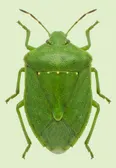
Larger and bright green with a flatter, classic shield-shaped body, unlike the small brown, strongly domed body of the Japanese common plataspid stinkbug.
Questions
Is the Japanese common plataspid stinkbug dangerous to people?
Mild. Its defensive fluid can cause a burning feeling and a red welt on bare skin, so it is best handled gently or not at all.
When can you see the Japanese common plataspid stinkbug?
The Japanese common plataspid stinkbug can be seen from April to November, by day.
Plate retouched from a photo by Timur Kalininsky, CC BY 4.0, iNaturalist Licence
Report a mistake in this entry
True bugs›Plataspid bugs›Megacopta
Last updated 2026-09-27. Every entry is checked against published sources.