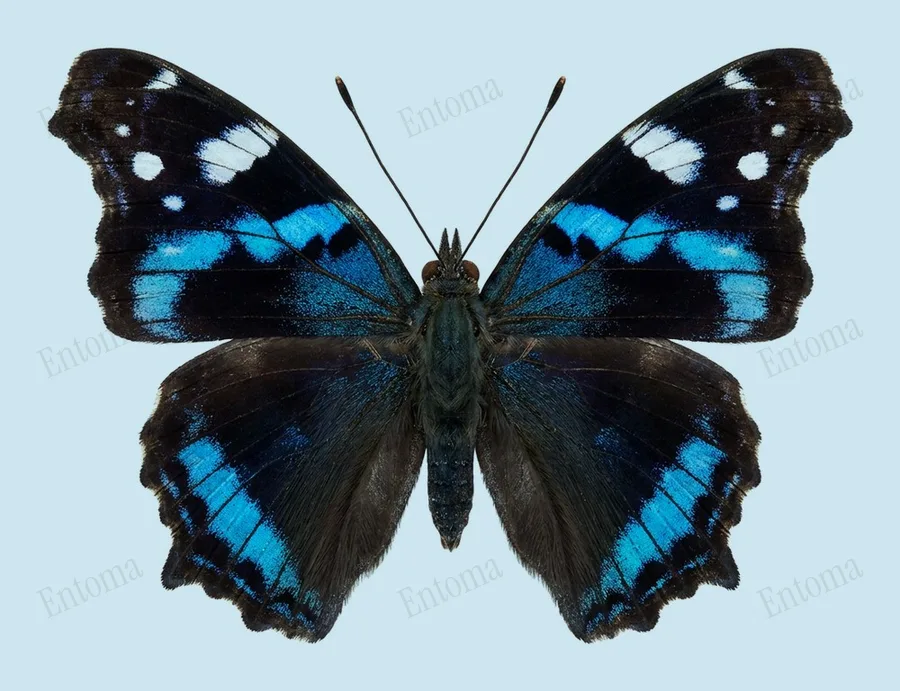
Blue admiral
When it closes its wings, this butterfly's mottled brown underside looks just like bark or a dead leaf, hiding the brilliant blue bands seen in flight.
| Where | Forests across East Asia |
|---|---|
| Size | 60 to 70 mm wingspan |
| When | March to November |
The upperside is dark blue to black with light azure bands crossing both wings and pale spots near the forewing tip, while the underside is a dull bark-like brown. The related Indian red admiral has deep orange-red bands instead of blue, with no azure tone.
Caterpillars feed on Smilax vines in forests and parks, and adults bask on tree trunks and paths, with two to three generations flying from spring through autumn.
Traits
Habitat
Woodland
Colour
Blue, Black
Active
Day
To people
Harmless to people; adults bask on tree trunks and paths.
Activity through the year
Often confused with
Has deep orange-red bands across dark wings with no blue tone, where the Blue admiral shows light azure bands instead.
Questions
Is the Blue admiral dangerous to people?
Harmless to people; adults bask on tree trunks and paths.
When can you see the Blue admiral?
The Blue admiral can be seen from March to November, by day.
Plate retouched from a museum specimen photo by National Museum of Nature and Science, Japan, CC BY 4.0, GBIF Licence
Report a mistake in this entry
Butterflies and moths›Brush-footed butterflies›Kaniska
Last updated 2026-09-27. Every entry is checked against published sources.