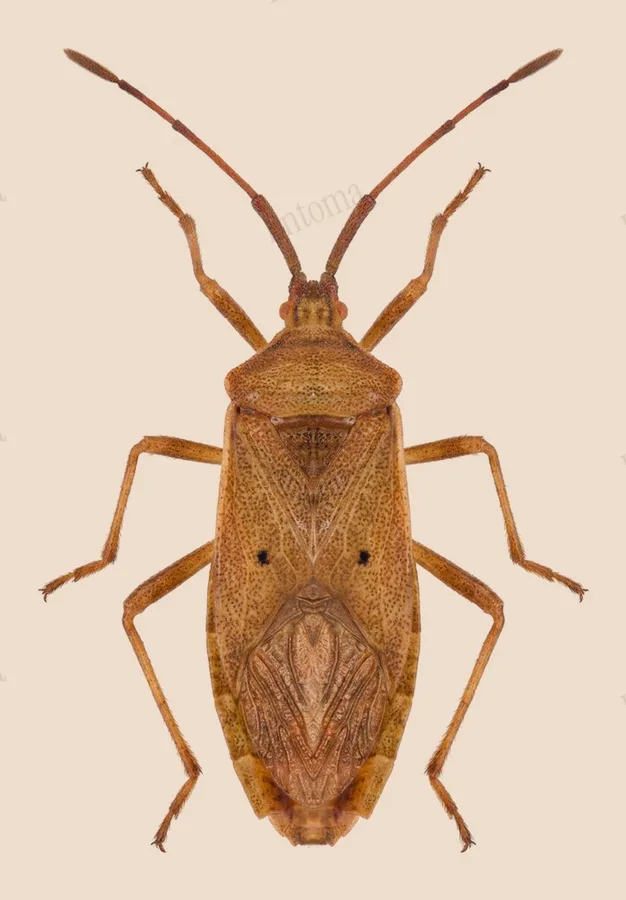
Homoeocerus unipunctatus
A single dark spot at the centre of each forewing gives this leaf footed bug its scientific name, which means one spotted.
| Where | Roadsides and fields with legumes |
|---|---|
| Size | 12 to 16 mm body length |
| When | April to October |
This slender, leaf footed bug is pale brown overall, with a single dark spot near the centre of each forewing that gives the species its scientific name.
It feeds by piercing the stems, leaves and pods of wild and cultivated legumes such as kudzu, wisteria and soybean, and releases a strong odour when handled or disturbed.
Traits
Habitat
Farmland
Colour
Brown, Black
Active
Day
To people
Releases a strong defensive odour if handled but does not bite; harmless to people.
Activity through the year
Often confused with
Has a shorter first antennal segment about as long as the head is wide and a blurred, indistinct central spot on the forewing, compared to this species' longer antennal segment and sharply defined spot.
Questions
Is Homoeocerus unipunctatus dangerous to people?
Releases a strong defensive odour if handled but does not bite; harmless to people.
When can you see Homoeocerus unipunctatus?
Homoeocerus unipunctatus can be seen from April to October, by day.
Plate retouched from a photo by りなべる, CC BY 4.0, iNaturalist Licence
Report a mistake in this entry
True bugs›Leaf-footed bugs›Homoeocerus
Last updated 2026-09-27. Every entry is checked against published sources.