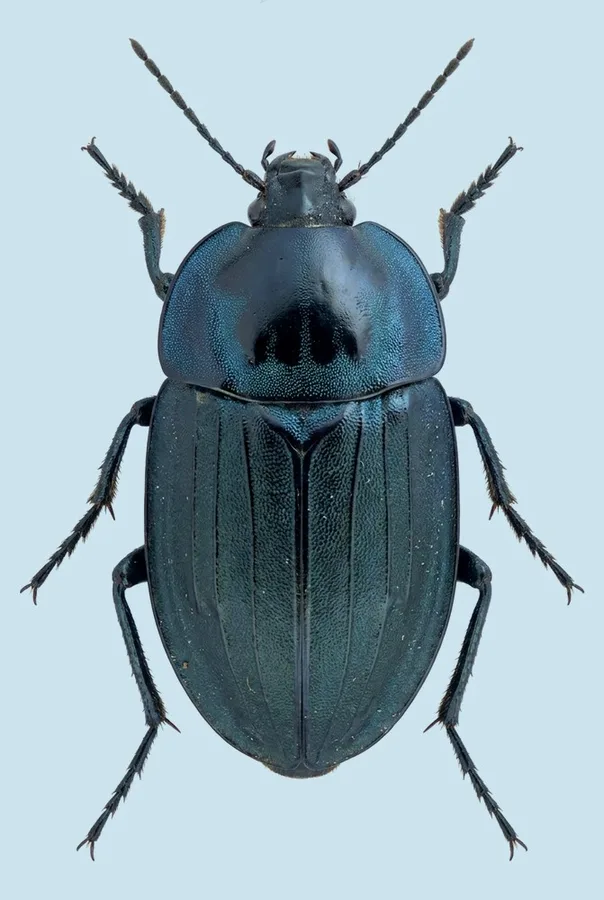
Eusilpha jakowlewi
This carrion beetle looks almost identical to a common Japanese relative, but shows a stronger blue sheen and one extra enlarged antennal segment.
| Where | Inland forests of Korea, Japan and China |
|---|---|
| Size | 18 to 23 mm body length |
| When | April to October |
This carrion beetle is black with a stronger blue sheen than its closest relative, a widespread flat carrion beetle it otherwise resembles closely in size and shape. The two are best told apart by the antennae, since this species has five enlarged terminal segments rather than four.
Adults and larvae both feed on carrion, breaking down dead animals and returning nutrients to the soil. It has a patchy, inland distribution rather than the fully coastal to mountain spread of its commoner relative.
Traits
Habitat
Woodland
Colour
Black, Blue
Active
Day and night
To people
Harmless to people; does not bite or sting.
Activity through the year
Often confused with
Has only four enlarged terminal antennal segments, rather than five, and a weaker blue tinge to its black body.
Questions
Is Eusilpha jakowlewi dangerous to people?
Harmless to people; does not bite or sting.
When can you see Eusilpha jakowlewi?
Eusilpha jakowlewi can be seen from April to October, by day and at night.
Plate retouched from a photo by 들꽃ㅅr랑, CC BY 4.0, iNaturalist Licence
Report a mistake in this entry
Last updated 2026-09-27. Every entry is checked against published sources.